Manufacturing and Sourcing in the Middle East: UAE, Saudi Arabia, Bahrain, and Oman
How the Gulf states are transforming into viable manufacturing destinations — what the UAE, Saudi Arabia, Bahrain, and Oman offer global buyers, which product categories make sense, and why third-party inspection with local presence is essential.
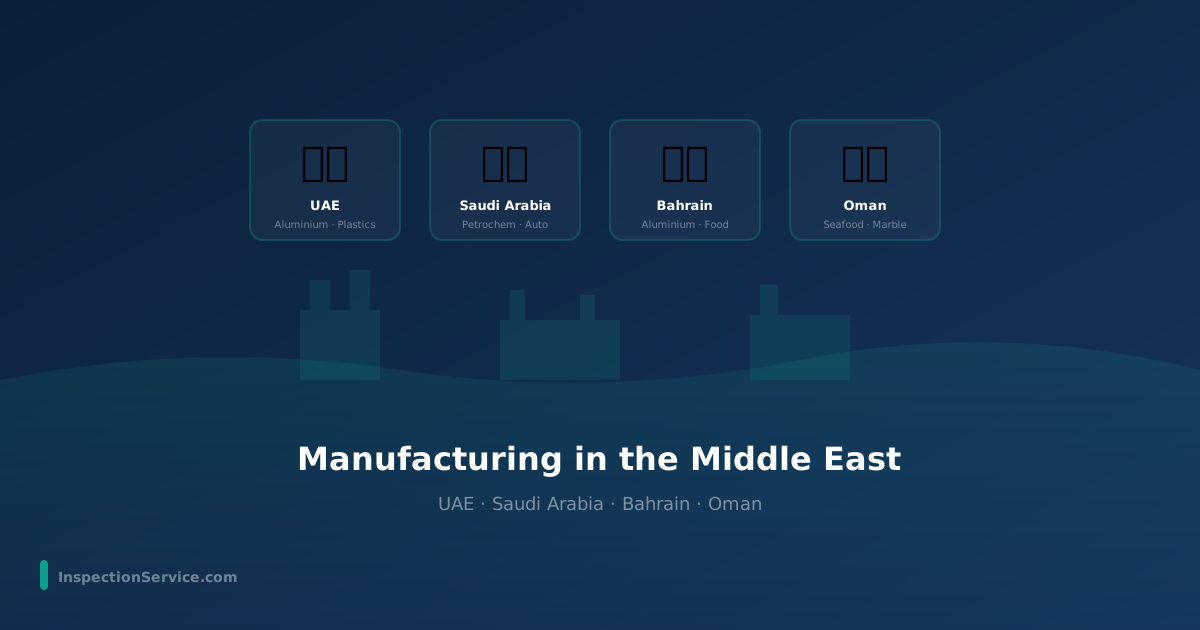
When global buyers think of manufacturing hubs, their minds typically go to China, Vietnam, India, or Bangladesh. Rarely does the Middle East feature in the conversation. Yet a quiet transformation has been underway across the Gulf states — particularly in the UAE, Saudi Arabia, Bahrain, and Oman — where billions of dollars in government investment, economic diversification programmes, and strategic geographic positioning are creating genuine manufacturing opportunities that forward-looking buyers should not ignore.
The Transformation: From Oil Dependency to Industrial Diversification
For decades, the economies of the Gulf Cooperation Council (GCC) states were built almost entirely on hydrocarbons. Oil and gas revenues funded the spectacular growth of cities like Dubai, Riyadh, and Doha — but the volatility of oil prices and the inevitability of the energy transition have driven every Gulf government to pursue aggressive economic diversification strategies.
These are not modest ambitions. Saudi Arabia's Vision 2030, the UAE's Operation 300bn strategy, Bahrain's Economic Vision 2030, and Oman's Vision 2040 each target substantial growth in non-oil manufacturing, with dedicated industrial zones, foreign investment incentives, and infrastructure development designed to attract global manufacturers.
Country-by-Country: What Each Market Offers
🇦🇪 United Arab Emirates
The UAE is the most industrially advanced of the Gulf states, with a manufacturing sector that already contributes over $40 billion to GDP. Dubai's Jebel Ali Free Zone — one of the world's largest — hosts more than 8,000 companies engaged in manufacturing, trading, and logistics. Abu Dhabi's KIZAD and ICAD industrial cities focus on heavier manufacturing including metals, chemicals, and building materials.
Emirates Global Aluminium (EGA) is one of the world's largest aluminium producers, and the UAE has developed meaningful capacity in plastics, packaging, food processing, pharmaceuticals, and building materials. The country's logistics infrastructure — including the world's busiest airport for international freight (Dubai) and major container ports — makes it an efficient hub for manufacturing and re-export.
🇸🇦 Saudi Arabia
Saudi Arabia is pursuing the most ambitious industrial transformation in the region. The kingdom is already a major global producer of petrochemicals (through SABIC and Saudi Aramco's downstream operations), fertilizers, and steel. Under Vision 2030, Saudi Arabia is aggressively expanding into automotive manufacturing (Lucid Motors has established its first international factory in Jeddah), defence manufacturing, food processing, and pharmaceuticals.
The development of new industrial megaprojects — including NEOM, King Abdullah Economic City, and the expansion of Jubail and Yanbu industrial complexes — is creating manufacturing capacity at a scale that will reshape the region's industrial landscape over the coming decade.
🇧🇭 Bahrain
Bahrain may be the smallest Gulf state, but it punches above its weight in manufacturing. Aluminium Bahrain (Alba) is one of the world's largest single-site aluminium smelters, producing over 1.5 million metric tonnes annually. This creates a downstream ecosystem of aluminium product manufacturers serving construction, automotive, and packaging markets globally.
Bahrain has also developed capacity in food processing, plastics, pharmaceuticals, and ship repair. The country's compact size, business-friendly regulations, and well-developed financial services sector make it accessible for international buyers exploring Gulf manufacturing for the first time.
🇴🇲 Oman
Oman's industrial development has accelerated significantly with the opening of the Duqm Special Economic Zone — a massive industrial complex on the Arabian Sea coast that positions Oman as a manufacturing gateway between Asia, Africa, and Europe. Sohar Industrial Port Area is another major hub hosting petrochemical plants, steel mills, and food processing facilities.
Oman has particular strengths in fisheries and seafood processing (a significant export industry), marble and natural stone, building materials, and petrochemical derivatives. The government's Vision 2040 strategy actively targets foreign investment in manufacturing and offers competitive incentives.
| Country | Key Manufacturing Sectors | Major Industrial Zones | Strategic Advantage |
|---|---|---|---|
| UAE | Aluminium, plastics, food processing, packaging, pharma | Jebel Ali FZ, KIZAD, ICAD, Dubai Industrial City | World-class logistics, free zone infrastructure, trade hub |
| Saudi Arabia | Petrochemicals, steel, automotive, food, defence | Jubail, Yanbu, KAEC, NEOM, Sudair | Massive domestic market, Vision 2030 investment, energy cost advantage |
| Bahrain | Aluminium, food processing, plastics, ship repair | BIIP, Salman Industrial City, Hidd | Alba smelter ecosystem, compact and accessible, business-friendly |
| Oman | Petrochemicals, seafood, marble, building materials | Duqm SEZ, Sohar Industrial Port, Rusayl | Strategic location between Asia/Africa, Duqm deep-water port |
Product Categories: Where the Middle East Makes Sense
The Gulf states will not compete with Southeast Asia on labour-intensive, high-volume consumer goods like garments or toys. Their competitive advantage lies in specific product categories where energy costs, raw material access, logistics positioning, or government investment create a genuine edge:
• Aluminium and metal products
• Petrochemical derivatives (plastics, polymers)
• Building materials (cement, steel, ceramics)
• Food processing and packaging
• Fertilizers and industrial chemicals
• Marble and natural stone
• Pharmaceuticals
• Processed seafood (Oman)
• Automotive assembly and parts (Saudi)
• Defence and aerospace components
• Renewable energy equipment (solar)
• Electronics assembly
• Advanced packaging
• EV battery components
• Modular construction products
Why Third-Party Inspection Is Critical in the Gulf
For international buyers exploring Middle Eastern manufacturing, the case for third-party inspection and factory audits is arguably even stronger than in more established manufacturing markets like China or India. Here is why:
| Challenge | Why Inspection Matters |
|---|---|
| New and unproven factories | Many Gulf manufacturing facilities have been established in the last 5–10 years. Quality management systems may still be maturing. A factory audit verifies actual capabilities before you commit. |
| Distance and limited buyer presence | Most Western buyers have no local office in the Gulf. An independent inspector acts as your on-the-ground presence, verifying quality at the source. |
| Rapid industrial scaling | The speed of industrial development means new suppliers are constantly entering the market. Independent verification helps separate genuinely capable manufacturers from those still developing. |
| Regulatory and specification compliance | Products destined for export must meet destination-market standards. Third-party inspection verifies compliance before shipment, preventing costly rejections on arrival. |
| Supply chain transparency | In a region with many trading companies alongside actual manufacturers, factory audits verify that your supplier is a genuine manufacturer — not just an intermediary. |
The Geographic Advantage: Three Hours to Three Billion Consumers
One of the most compelling reasons to consider Gulf manufacturing is geography. The Middle East sits at the crossroads of three continents — within a three-hour flight radius of markets containing over three billion consumers across South Asia, East Africa, Central Asia, and Southern Europe. Major container shipping routes between Asia and Europe pass directly through Gulf ports, making the region a natural logistics hub.
For buyers serving markets in Africa, the Middle East, South Asia, or Southern Europe, manufacturing in the Gulf can offer significantly shorter transit times than shipping from East Asia. The UAE's port and airport infrastructure, in particular, rivals anything in the world — Jebel Ali port in Dubai is the largest in the Middle East and among the top ten globally.
Getting Started: How to Source from the Middle East
If the Middle East is on your sourcing radar, the practical steps mirror what you would do in any new manufacturing market. Start by identifying specific product categories where Gulf manufacturers have genuine capability — aluminium products, petrochemical derivatives, building materials, and food processing are the strongest starting points. Research suppliers through industry directories, trade shows (like the annual Abu Dhabi Industrial Expo and Saudi Arabia's Future Minerals Forum), and sourcing platforms.
Before placing any order, commission a factory audit from a qualified third-party provider with local presence in the Gulf. This is non-negotiable for a market where many facilities are relatively new. For ongoing orders, implement pre-shipment inspections on every shipment until the supplier has established a consistent quality track record.