The US-China Trade War: Impact on Buyers, Supply Chain Shifts, and What Comes Next
How the US-China trade war — from its 2018 origins through 2026 — has reshaped global sourcing, driven supply chain diversification, and created both challenges and opportunities for buyers.
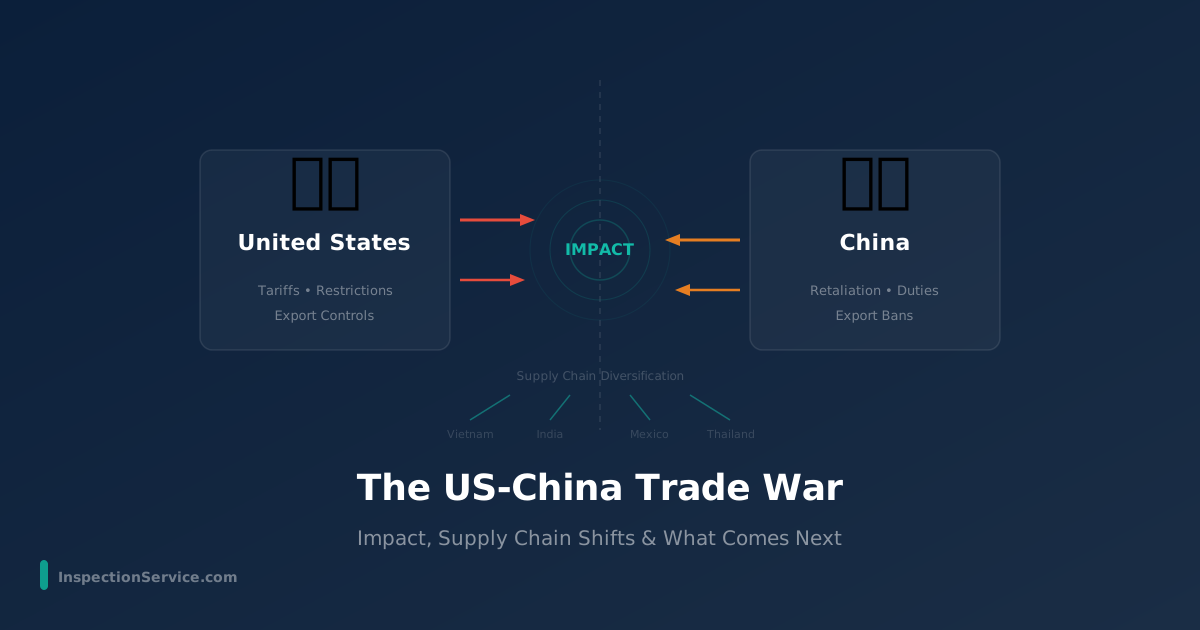
The trade conflict between the United States and China, which formally began in 2018, has fundamentally reshaped global supply chains, altered sourcing strategies for thousands of companies, and accelerated the diversification of manufacturing away from China into alternative production bases across Asia. This article traces the history, impact, and future outlook of a trade dispute that shows no signs of full resolution.
How It Started: 2018
The US-China trade war officially began on July 6, 2018, when the Trump administration imposed a 25% tariff on $34 billion worth of Chinese imports under Section 301 of the Trade Act of 1974. The action was framed as a response to China's alleged unfair trade practices — including forced technology transfer, intellectual property theft, and state subsidies that disadvantaged American manufacturers.
The initial tariffs targeted industrial and technology products aligned with China's "Made in China 2025" strategy — robotics, aerospace, automotive, and electronics components. Notably, mass-market consumer goods like clothing, toys, and smartphones were initially spared. China immediately retaliated with equivalent tariffs on $34 billion of US exports, targeting agricultural products like soybeans, pork, and dairy — striking at politically sensitive farm-state economies.
Escalation: 2018–2019
The Biden Era: 2021–2024
Despite expectations that the Biden administration might roll back tariffs, most Section 301 tariffs remained in place throughout Biden's term. In fact, in 2024, the administration increased tariffs on specific strategic sectors: the tariff rate on Chinese EVs was raised to 100%, semiconductors to 50%, and solar cells to 50%. The approach shifted from broad trade pressure to targeted "strategic decoupling" — protecting specific US industries while maintaining broader trade flows.
Trump 2.0 and Escalation: 2025–2026
The return of the Trump administration in January 2025 brought a dramatic escalation. New tariffs were imposed under the International Emergency Economic Powers Act (IEEPA), including a 20% "fentanyl-related" tariff on all Chinese goods and, briefly, tariff rates reaching as high as 125% on certain product categories. The escalation triggered market turmoil and significant disruption to importers.
In a landmark legal development, the US Supreme Court ruled in early 2026 that the sweeping IEEPA tariffs were unlawful, forcing the administration to pursue tariff authority through traditional channels (Section 301, Section 232). A series of negotiations between May and November 2025 resulted in a partial trade truce, with tariff rates reduced to 10% on many goods and further extended through November 2026.
Impact on US Buyers
For American importers and retailers, the trade war has had profound effects on costs, planning, and strategy. Products that were previously sourced from China with no or minimal duties suddenly faced 25% or higher tariff rates, squeezing margins and forcing difficult choices between absorbing costs, raising prices, or finding alternative suppliers.
Supply Chain Diversification: Who Benefited?
The trade war accelerated a trend that was already underway — the diversification of manufacturing away from China into alternative production bases. The countries that benefited most were those with existing manufacturing capability, competitive labour costs, and trade agreements with Western markets:
| Country | Key Growth Industries | Why It Benefited |
|---|---|---|
| Vietnam | Electronics, garments, footwear, furniture | Samsung investment, CPTPP/EVFTA trade deals, young workforce |
| India | Electronics, pharmaceuticals, textiles, auto parts | PLI incentives, massive domestic market, "Make in India" push |
| Bangladesh | Garments, textiles | Lowest labour costs, EU EBA trade preferences |
| Mexico | Automotive, electronics, appliances | USMCA proximity, nearshoring advantage |
| Thailand | Automotive, electronics, food processing | Mature industrial base, Japanese manufacturing presence |
| Cambodia | Garments, footwear | EU GSP preferences, low labour costs |
| Indonesia | Textiles, footwear, nickel/EV batteries | Natural resources, large workforce, growing industrial zones |
Challenges of Diversification
While the "China+1" strategy sounds straightforward in theory, execution has proven challenging for many buyers. Alternative manufacturing countries often lack the deep supply chain ecosystems, infrastructure quality, and production scale that China offers. Lead times are frequently longer, quality management systems are less mature, and the learning curve for new supplier relationships is steep.
Critically, many of these alternative manufacturing bases still depend on Chinese raw materials, components, and intermediate goods — meaning that tariffs on Chinese inputs can increase costs even for products assembled elsewhere. True supply chain independence from China remains elusive for most product categories.
What to Expect Going Forward
The US-China trade relationship is likely to remain contentious regardless of which administration is in power. The bipartisan consensus in Washington views China as a strategic competitor, and some level of tariffs and trade controls appears to be a permanent feature of the landscape. For importers and buyers, this means building supply chains that can adapt to shifting tariff regimes, investing in supplier relationships across multiple countries, and maintaining rigorous quality control — especially when working with newer, less proven suppliers in emerging manufacturing markets.
Independent quality inspection and factory audit services become even more valuable in this environment. As buyers diversify into countries where they have less experience and fewer established relationships, third-party verification provides the confidence and risk mitigation that successful sourcing requires.