BSCI vs SMETA vs SA8000: Which Social Compliance Audit Do You Need?
Three names dominate social auditing — and they are not interchangeable, not mutually recognized, and priced very differently. What each one actually is, and the one question that decides which you need before anyone pays for an audit.
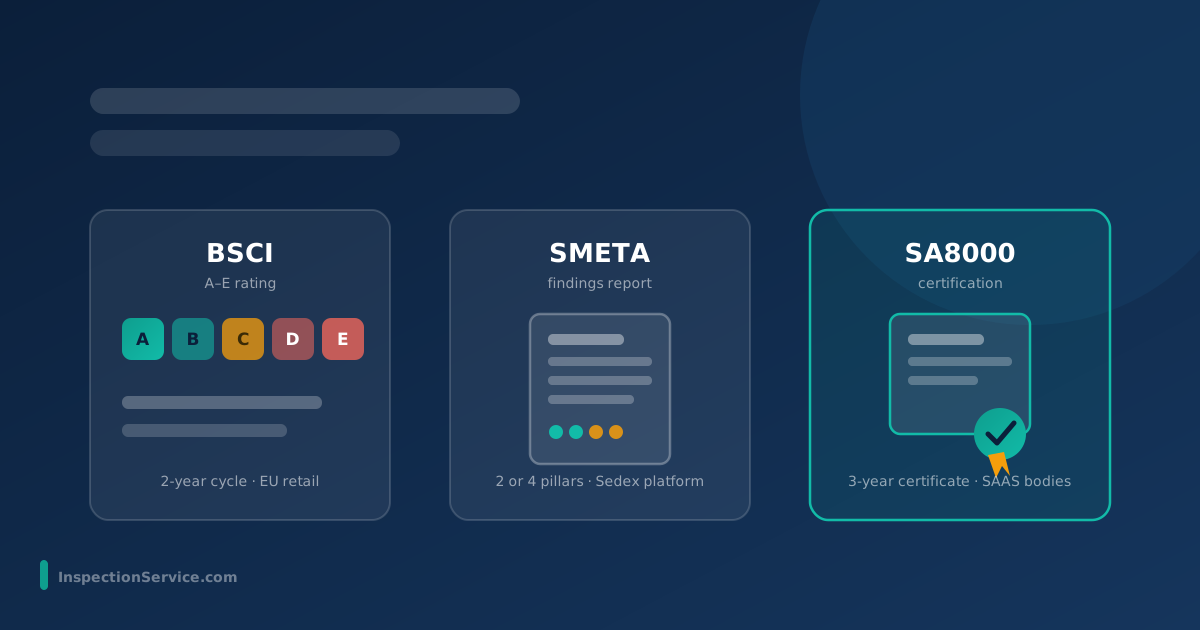
Sooner or later, most factories selling to Western buyers — and most importers sourcing from them — run into the same email: “Please provide a valid social compliance audit report.”
Then comes the confusion. The factory has a BSCI report; the buyer wants SMETA. Or the buyer says “social audit” without naming a scheme, the factory buys the wrong one, and a $1,500 audit has to be done twice. The three names that dominate this space — amfori BSCI, SMETA (Sedex) and SA8000 — check broadly similar things but are not interchangeable, not mutually recognized, and priced very differently.
This guide explains what each one actually is, how they differ in practice, and the one question that decides which you need — before anyone pays for a social compliance audit.
First: what a social compliance audit checks
Whatever the scheme, the core scope is similar, built on International Labour Organization (ILO) conventions and local labour law. An auditor spends one or more days on site checking:
- Child labour and forced labour — age documentation, recruitment practices, freedom of movement
- Wages and working hours — payroll records vs. legal minimum wage, overtime limits and premiums
- Health and safety — fire exits, protective equipment, chemical storage, dormitories and canteens where applicable
- Freedom of association — workers' right to organize, grievance mechanisms
- Discrimination and disciplinary practices
- Management systems — whether policies exist, are implemented, and survive staff turnover
The differences between BSCI, SMETA and SA8000 are less about what is checked and more about who owns the scheme, who accepts the result, what the output is, and how much rigour — and cost — is involved.
amfori BSCI — the EU retail standard
What it is: BSCI (Business Social Compliance Initiative) is run by amfori, a Brussels-based business association. It is not a certification — it is an audit framework whose results live on amfori's platform, visible to amfori's member companies (mostly European retailers and importers).
The output: a rating from A to E against the amfori BSCI Code of Conduct. There is no “certificate” — there is an audit report and a rating.
Validity and cycle: a rating of A or B means the next full audit is due within two years. A rating of C, D or E triggers a follow-up audit within 2–12 months focused on the corrective actions.
Who asks for it: predominantly EU retailers and brands — BSCI is the default social audit across much of continental European retail.
SMETA (Sedex) — the most widely used audit format
What it is: SMETA (Sedex Members Ethical Trade Audit) is an audit methodology owned by Sedex, a UK-based platform. Like BSCI, it is not a certification — it is a standardized audit whose report is uploaded to the Sedex platform and shared with the buyers the factory links to.
Two versions:
- 2-Pillar — labour standards + health and safety (the core)
- 4-Pillar — adds environment and business ethics modules
If your buyer doesn't specify, ask — the 4-pillar takes longer and costs more.
The output: no rating, no pass/fail. SMETA produces a findings report — non-compliances, observations and good examples — plus a corrective action plan (CAPR). Each buyer decides for itself what findings it will tolerate. Two buyers can read the same SMETA report and reach different decisions.
What changed recently: Sedex rolled out SMETA 7.0 in 2025 — the current methodology adds a Management Systems Assessment (how well the factory's own systems prevent problems, not just whether problems were found on audit day), more structured worker interviews, and a “Collaborative Action Required” category for systemic issues like living wages that no single factory can fix alone. If you had a SMETA audit before 2025, expect the next one to probe deeper into management systems.
Validity: formally, a SMETA report doesn't expire — but most buyers treat it as valid for 12 months, some 24. The buyer's policy is what counts.
Who asks for it: UK retailers overwhelmingly, plus a broad international base — Sedex is the largest of the platforms, and SMETA reports are the closest thing to a lingua franca in social auditing. Note, however, that recognition is one-directional in practice: many SMETA-accepting buyers will look at other audits, but amfori BSCI does not recognize SMETA reports.
SA8000 — the actual certification
What it is: SA8000 is a certifiable management-system standard owned by Social Accountability International (SAI), modeled on the structure of ISO standards. This is the one scheme of the three where the word “certificate” is correct.
The output: a certificate valid for three years, issued by an SAAS-accredited certification body, with surveillance audits during the cycle to keep it valid.
The bar: substantially higher than BSCI or SMETA. SA8000 requires the factory to build and run a social management system — a social performance team, worker representation, internal audits, documented remediation — not just pass an inspection day. Certification typically takes months of preparation.
The cost: a different league. Audit fees commonly run $350–1,000 per man-day depending on country, with 5–20 man-days across the certification cycle depending on workforce size — initial certification alone often lands at $5,000–20,000+, before any consultant or system-building costs.
Who asks for it: brands with premium sustainability positioning, some US and EU buyers in sensitive categories, and supply chains where social performance is a marketing claim that needs hard backing. It is the rarest of the three demands — and the one factories should never pursue “just in case,” given the cost.
Worth knowing: WRAP (US apparel/footwear), ICS (French retail) and RBA (electronics) are other schemes you may encounter; the decision logic below applies to them equally.
The comparison at a glance
| amfori BSCI | SMETA (Sedex) | SA8000 | |
|---|---|---|---|
| Type | Audit + rating (no certificate) | Audit report (no rating, no pass/fail) | Certification |
| Owner | amfori (Brussels) | Sedex (London) | SAI (New York) |
| Output | A–E rating on amfori platform | Findings + CAPR on Sedex platform | 3-year certificate |
| Validity | 2 years (A/B); follow-up in 2–12 months (C–E) | Buyer policy — typically treated as 12 months | 3 years with surveillance audits |
| Scope options | One code, full scope | 2-Pillar or 4-Pillar | Full standard |
| Initiated by | Buyer (amfori member) | Factory or buyer via Sedex | Factory (certification applicant) |
| Typical demand from | EU retail | UK retail + global | Premium brands, sensitive categories |
| Relative cost | $$ (1–3 man-days) | $$ (1–4 man-days; 4-pillar higher) | $$$$ (certification cycle) |
| Recognizes the others? | Does not recognize SMETA | Buyer-dependent | N/A — different category |
The only question that matters: who is asking?
- Your buyer or their retailer says BSCI → it's BSCI, arranged through their amfori membership.
- They say SMETA or “upload to Sedex” → it's SMETA; confirm 2-pillar or 4-pillar before booking.
- They demand certified social accountability → SA8000, and budget accordingly.
- They just say “a social audit” with no scheme → ask them to name one in writing before spending anything. If they genuinely have no preference, a SMETA 2-pillar is the most widely readable default.
For importers: if you are the one imposing the requirement on your supplier, pick the scheme your own customers or market expects, and remember an audit is a snapshot — the corrective action plan and the follow-up are where the actual improvement happens. A C-rated BSCI factory that closes its findings is often a better bet than an unaudited factory with a clean-looking showroom.
What it costs, and who pays
BSCI and SMETA audits are priced per man-day, like any factory audit. Duration scales with workforce size — a small factory is typically 1–2 man-days; large sites or 4-pillar SMETA run longer. Scheme rules add cost versus a generic audit: the audit firm must be approved for the scheme (amfori-approved, Sedex affiliate, or SAAS-accredited respectively), and accredited man-day rates run higher than the $250–350 typical of a generic quality audit.
Who pays is commercial custom, not regulation: for BSCI it is often the factory (the amfori member requests, the factory hosts and usually pays), SMETA either way, SA8000 essentially always the factory, since it owns the certificate. Factories increasingly treat a current audit as a cost of accessing Western customers — which is exactly why speculative, wrong-scheme audits sting so much.
How this connects to your quality program
A social compliance audit answers one question: is this factory treating its workers legally and safely? It says nothing about whether your products will arrive defect-free — that is what product inspections are for, and the two run on completely separate tracks: different auditors, different checklists, different schedules. A factory can hold an A-rated BSCI report and still ship you 10,000 faulty units. Serious buyers run both: audit the factory before or at the start of the relationship, inspect the goods every order — and for capability questions in between, there is the capability & quality audit.
Frequently asked questions
No. A BSCI audit produces a rating (A–E) on the amfori platform, visible to amfori members. There is no certificate document, and anyone offering to sell you a “BSCI certificate” directly is a red flag.
Formally it doesn't expire — the report is a snapshot. In practice most buyers require one no older than 12 months, some accept 24. The buyer's policy decides.
Sometimes, but never assume. Recognition is at each buyer's discretion, and amfori BSCI does not recognize SMETA reports on its platform. Always confirm in writing before relying on an existing report.
2-pillar covers labour standards and health & safety. 4-pillar adds environment and business ethics modules — more audit time, higher cost. Confirm which one your buyer requires before booking.
Not usually. BSCI audits are initiated through an amfori member (the buyer), which links the factory on the amfori platform. A factory whose customer demands BSCI should ask that customer to start the process.
BSCI and SMETA audits are priced per man-day and scale with factory size — typically 1–4 man-days, at rates above generic audit pricing because scheme-approved auditors are required. SA8000 is a multi-year certification programme, commonly $5,000–20,000+ for initial certification depending on country and workforce size.
All three schemes support announced, semi-announced (an audit window, not a date) and unannounced audits. Buyers increasingly prefer semi-announced or unannounced for credibility — the scheme and buyer set this, not the factory.