Critical, Major and Minor Defects Explained (With Examples)
Every inspection result comes down to one thing: how the defects were classified. Here's what critical, major, and minor actually mean, real examples by product type, and how each class maps to an AQL.
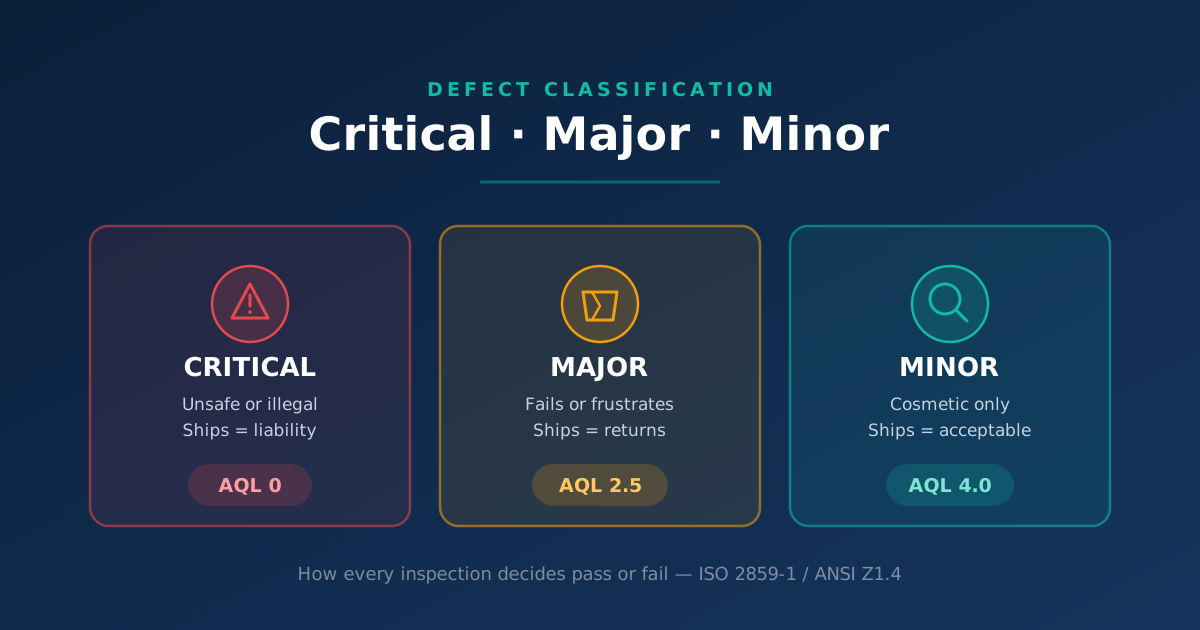
Two inspectors can look at the same carton of goods and reach opposite conclusions — not because they disagree about what they're seeing, but because they disagree about what it means. One calls a loose button a minor defect. The other calls it major. That single judgement can be the difference between a shipment that leaves the factory and one that doesn't.
This is the part of quality control buyers most often skip. They agree an AQL, they book the pre-shipment inspection, and they assume "defect" is a self-evident word. It isn't. Every inspection result is produced by sorting problems into three buckets — critical, major, and minor — and comparing the count in each bucket against a separate accept/reject number. Get the classification wrong and your AQL is measuring the wrong thing.
Why defect classification decides pass or fail
An AQL inspection doesn't produce a score. It produces a comparison. The inspector pulls a random sample, counts the defects found, sorts them by class, and compares each count against that class's accept number. If any class exceeds its limit, the lot fails.
That means the classification step is doing the real work. The same physical problem — say, a scratch on a laptop lid — could be minor (it's on the underside, nobody sees it), major (it's across the front and customers will return it), or even critical (it has exposed a sharp metal edge). Nothing about the scratch changed. What changed is the judgement about consequence.
The three defect classes defined
The definitions below follow the classical framework used in ISO 2859-1 and ANSI/ASQ Z1.4, translated into buyer language.
Critical defects
A critical defect is one that is likely to result in hazardous or unsafe conditions for anyone using, handling, or maintaining the product — or that breaches a mandatory legal or regulatory requirement in your destination market.
Critical defects are not a quality problem; they're a liability problem. A single one can mean a recall, a customs seizure, a lawsuit, or someone getting hurt. This is why the standard convention is AQL 0 — zero tolerance: find one critical defect in the sample and the lot fails, regardless of how clean everything else is.
Major defects
A major defect is one that is likely to cause the product to fail, or materially reduce its usability for its intended purpose. In commercial terms: a customer who received this unit would probably return it, complain, or refuse to buy it again.
Major defects don't hurt anyone — they hurt your margin, your reviews, and your reorder rate. The common AQL is 2.5, though buyers with premium positioning often tighten it to 1.5 or 1.0.
Minor defects
A minor defect is a departure from the agreed standard that doesn't materially affect usability. A customer might notice it, but it wouldn't stop them using the product or send them back to the returns page.
Minor defects are the cost of manufacturing at scale — no factory produces a perfect unit every time, and pretending otherwise just makes your goods more expensive. The common AQL is 4.0.
Real examples by product category
Definitions only get you so far. Here's how the same three classes look across four common sourcing categories.
| Category | Critical | Major | Minor |
|---|---|---|---|
| Apparel & textiles | A broken needle or sharp metal fragment left in a garment; missing mandatory care or fibre labelling; a drawstring on children's outerwear that breaches the applicable safety standard | Open seam, broken zip, hole, measurement outside the agreed tolerance, visible shade mismatch between panels, wrong size on the label | Loose thread ends, slight shading within tolerance, a small mark in a concealed area, light puckering |
| Electronics | Exposed live conductor, missing earth connection, wrong voltage rating for the market, a battery that overheats, missing a required safety mark | Unit won't power on, a button or port that doesn't work, cracked housing, wrong plug type for the destination | Light scratch on the base, slightly off-centre printing, minor scuff on the retail box |
| Furniture | Structure fails under its rated load, sharp edges or splinters on a contact surface, a tip-over hazard on tall units | Wobbles when assembled, missing fittings or hardware, veneer lifting, doors or drawers badly misaligned | Small scratch on the underside, minor glue residue, slight grain variation |
| Toys | A small part that detaches and presents a choking hazard, sharp points or edges, restricted chemicals, missing age warnings where required | A feature that doesn't work, a component broken in the box, wrong item in a multi-pack | Slight print misalignment on packaging, minor colour variation from the approved sample |
Notice the pattern: critical is about harm and law, major is about function and returns, minor is about appearance. If you can't decide which bucket something belongs in, ask what happens when it reaches the customer. Does someone get hurt or does it break a rule? Critical. Does it come back? Major. Does it just look slightly off? Minor.
How defect classes map to AQL levels
Each defect class carries its own AQL, and each AQL produces its own accept/reject number from the same sample. A typical general-merchandise inspection of a 5,000-unit lot at General Level II draws a 200-piece sample and applies something like this:
| Defect class | AQL | Sample | Accept ≤ | Reject ≥ |
|---|---|---|---|---|
| Critical | 0 (zero tolerance) | 200 | 0 | 1 |
| Major | 2.5 | 200 | 10 | 11 |
| Minor | 4.0 | 200 | 14 | 15 |
Read that carefully, because it's the whole logic of an inspection in one table. From the same 200 pieces, the inspector can accept up to 14 minor defects, up to 10 major ones, and exactly zero critical ones. Eleven major defects fails the lot. So does a single critical defect — even if the other 199 units are flawless.
Those numbers aren't arbitrary; they come straight from the ISO 2859-1 tables. You can generate them for your own order quantity with our free AQL sample size calculator — enter your lot size and AQLs and it returns the sample size and accept/reject number for each class. If you want to understand where the numbers come from, our guide to AQL tables and sample sizes walks through the code letters and lookups.
Who decides the classification — and when
Here's the part that causes most disputes: the classification is yours to define, not the inspector's to guess.
A good inspection provider will apply a sensible default classification based on your product category and their experience. But "sensible default" is doing a lot of work in that sentence. Your tolerance for a shade variation on a fashion garment is not the same as a workwear brand's. Your definition of an acceptable scratch on a premium product is not the same as a value brand's.
The fix is a defect classification list (sometimes called a defect list or classification sheet): a written document, agreed with your supplier before production starts, that names the defects specific to your product and assigns each one to a class. It should be attached to your purchase order and handed to the inspector along with your specification and approved samples.
The timing matters. Agreeing classification before production means the factory knows exactly what will fail and can build to it. Agreeing it after an inspection fails means you're now negotiating with a supplier who has a warehouse full of finished goods and every incentive to argue that your major is really a minor.
The grey areas (and how to close them)
Some judgements are genuinely hard. These are the ones that come up most:
- Location matters, so say so. A 5mm scratch on the front face and the same scratch on the underside are not the same defect. Define zones — visible surface, secondary surface, concealed — and classify by zone.
- Size thresholds need numbers. "A small stain is minor" is unenforceable. "A stain under 3mm in a concealed zone is minor; over 3mm or in a visible zone is major" is a rule an inspector can apply consistently.
- Accumulation. One loose thread is minor. Fifteen loose threads on one garment may add up to a unit no customer would accept. Decide whether multiple minors on a single unit escalate to a major.
- The approved sample is the reference. Most colour and finish disputes evaporate when there's a sealed golden sample both sides signed off. Without one, "wrong shade" is an opinion.
- Regulatory defects are never negotiable. If a defect breaches a mandatory requirement in your destination market, it's critical — regardless of how minor it looks or how much the supplier protests.
Writing a defect list that actually works
A workable classification list is short, specific, and unambiguous. In practice:
- Start from real failures. Your returns data and previous inspection reports tell you which defects actually occur on your product. Classify those first rather than trying to imagine every possibility.
- Use measurable language. Millimetres, zones, and tolerances — not "excessive", "noticeable", or "poor".
- Photograph both sides of the line. One photo of an acceptable unit and one of a rejectable unit removes more argument than a page of text.
- Keep critical short and absolute. If your critical list has thirty entries, it isn't a critical list. It should cover safety and legal compliance, and nothing else.
- Review it after each inspection. Every dispute is a gap in the list. Close it before the next order.
Once it's written, it belongs in the inspection booking. Our guide on what a product inspection report should contain covers how classification should appear in the results you get back — every defect logged, classified, photographed, and counted against its AQL.
Frequently asked questions
A major defect materially reduces the product's usability or is likely to cause a customer return or complaint — a broken zip, a unit that won't power on. A minor defect is a departure from the agreed standard that doesn't affect use, such as a loose thread or a small mark in a concealed area. The practical test is whether the customer would send it back.
Because critical defects involve safety hazards or breaches of mandatory regulations, and there is no commercially sensible number of unsafe or illegal units to accept. At AQL 0 the accept number is zero and the reject number is one — a single critical defect in the sample fails the entire lot.
You do, as the buyer. Inspection providers apply a reasonable default classification for your product category, but the authoritative version is the defect classification list you agree with your supplier before production and hand to the inspector with your specification and approved samples.
Only if your defect list says so. Accumulation isn't handled automatically by the AQL tables, so if you want multiple minor defects on a single unit to escalate to a major, write that rule into your classification list explicitly.
The most widely used combination for general consumer goods is 0 for critical, 2.5 for major, and 4.0 for minor. Premium or higher-risk products often tighten major to 1.5 or 1.0. You can see exactly how each choice changes your sample size and accept/reject numbers with our free AQL sample size calculator.
Get the classification right before you get the quote
Defect classification is the cheapest quality tool you have. It costs nothing but an afternoon and a conversation with your supplier, and it determines whether every inspection you ever book measures the thing you actually care about. An AQL applied to a vague defect list is just a number with a false sense of precision attached.
Write the list. Agree it early. Photograph the edge cases. Then let the sampling do its job.