Factory Audits in China: What Buyers Should Check Before the First Order
China's supplier base runs from world-class plants to back-street workshops, and it's hard to tell which from a website. What a China factory audit should check, and how to plan one.
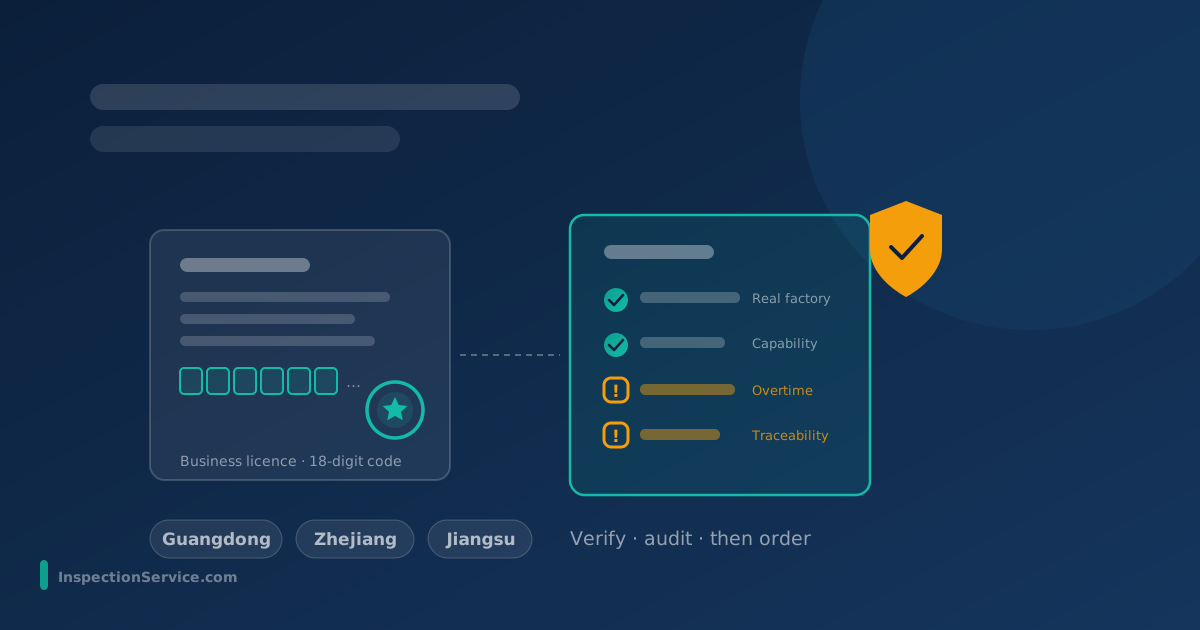
China exported about $3.77 trillion of goods in 2025, more than any country in history, made by hundreds of thousands of factories ranging from world-class plants to back-street workshops. That range is exactly why a factory audit matters more in China than almost anywhere else. From an online listing or a polished video call, it's hard to tell which kind of supplier you've found.
An audit is a structured on-site assessment of a supplier, usually before or early in the relationship. This guide covers what a China audit should check, the China-specific risks it's designed to catch, food supplier audits, and how to plan one. For choosing the company that does the audit, see our guide to choosing a quality control company in China.
Start with the basics: is it a real factory?
A large share of Chinese “manufacturers” online are trading companies. That isn't automatically a problem: good traders manage production and quality well. But you need to know who actually makes your goods, because quality, pricing and accountability all depend on it.
Some checks you can do before anyone visits:
- Business licence: every legally registered mainland company appears in the government's National Enterprise Credit Information Publicity System, searchable by company name or its 18-character Unified Social Credit Code. Check that the name, code, registered address and business scope match what the supplier has told you, and that the same code appears on contracts and invoices.
- Business scope: a manufacturer's licence usually lists production activities. A trading company's lists sales, import and export. A mismatch isn't proof, but it's a question to ask.
- Address: compare the registered address with the factory address you've been given. Many legitimate factories have a separate sales office, but you should know which site will make your order.
Which audit, for what question
Audits answer different questions (the full overview is here). For a Chinese supplier, the usual ones are:
| Audit | The question it answers | When |
|---|---|---|
| Supplier verification / capability & quality | Is this a real factory, and can it make my product, at my volume, to my standard? | Before the first PO: the default first audit |
| Social compliance (BSCI / SMETA / SA8000) | Does it meet the labour standards my customers require? | Often required by EU and UK retailers |
| Environmental | Will it create environmental or regulatory exposure? | Chemical, dyeing, plating and finishing processes |
| Security / C-TPAT | Is the supply chain secure enough for my customs programme? | US importers in trusted-trader schemes |
| Food safety / GFSI | Does a food supplier meet food-safety requirements? | Food and food-contact suppliers |
Which social scheme you need depends on who's asking: here's how BSCI, SMETA and SA8000 differ. To book any of these, see our factory & supplier audit service.
China-specific risks an audit should cover
1. Working hours. China's Labour Law caps overtime at 36 hours a month (and three hours a day), but auditors routinely find much longer hours in export factories, especially before peak shipping seasons. It's one of the most common findings in Chinese social audits. A good auditor checks attendance and payroll records against worker interviews, because factories sometimes keep separate records for audits.
2. Forced-labour exposure for US-bound goods. Under the US Uyghur Forced Labor Prevention Act (UFLPA), goods made wholly or partly in Xinjiang, or by companies on the UFLPA Entity List, are presumed to involve forced labour and can be detained at the US border. That applies anywhere in the supply chain, including raw materials. Detentions have hit electronics, batteries, automotive parts, solar, textiles and more, and China accounted for over 80% of them. For US-bound goods, an audit should include supply-chain mapping and traceability for key materials, not just the final factory.
3. Unauthorised subcontracting. Busy factories sometimes move part of an order to smaller workshops to hit deadlines. A capability audit establishes the factory's real capacity, so you can tell when an order is too big for it, and an in-process inspection confirms your goods are on the audited lines.
4. Capability drift. A factory that passed an audit two years ago may have changed owners, moved, lost key staff or added new product lines. Re-audit periodically, and after any major change.
Food supplier audits in China
For food and food-contact products, a general factory audit isn't enough. Buyers usually look for:
- Certification to a recognised food-safety scheme, such as BRCGS, FSSC 22000 or IFS (all GFSI-recognised), plus HACCP. Check the certificate is current and covers the products and site you're buying from.
- An independent supplier audit against your own requirements: hygiene and pest control, raw-material traceability, allergen management, foreign-body controls (metal detection or X-ray), cold chain, and recall procedures.
- Food-contact compliance, for packaging and kitchenware, against the destination market's rules (EU food-contact regulations, FDA, LFGB), with lab testing where required.
Costs and timing
Audits are priced per man-day, and in China they cost more per man-day than standard product inspections (the cost logic explained here). A capability audit of a small or mid-size factory is often one to two man-days, while social compliance audits depend on the scheme and workforce size. Scheme audits (BSCI, SMETA, SA8000) require approved auditors and cost more again. Ask providers to quote for your specific factory and scope.
Plan around Chinese New Year, which falls on 6 February 2027. Factories close for two to four weeks, and audit slots fill up in the weeks before. Book early, and avoid auditing in the first weeks after the restart, when staffing is unusual.
The bottom line
Verify the business licence, then audit on site before the first order: capability first, then the social, environmental or food-safety scheme your customers require. For US-bound goods, add supply-chain traceability for forced-labour risk. An audit costs a fraction of one bad order, and it's the best evidence you'll have if anything goes wrong later.
Compare free quotes from vetted audit providers in China, with local auditors across the major manufacturing regions.
Frequently asked questions
Search its business licence in the National Enterprise Credit Information Publicity System, compare the business scope and address with what you've been told, then confirm on site with a supplier verification or capability audit.
A capability and quality audit checks the business licence, production lines, machinery, capacity, workforce and quality system. Social compliance audits check labour practices such as working hours, wages and worker treatment.
The Labour Law caps overtime at 36 hours a month and three hours a day. Excessive overtime is one of the most common findings in Chinese factory audits.
Yes. Under the UFLPA, goods made wholly or partly in Xinjiang, or by listed entities, are presumed to involve forced labour and can be detained, so supply-chain tracing for key materials matters.
Usually certification to a GFSI-recognised scheme such as BRCGS, FSSC 22000 or IFS, plus HACCP, backed by your own supplier audit covering hygiene, traceability, allergens and foreign-body controls.
Before the first order, and well before Chinese New Year (6 February 2027), when factories close for weeks and audit slots fill up early.