During-Production Inspection (DUPRO): What Actually Happens Mid-Run
A DUPRO is the least understood of the three standard inspections — a diagnosis of a process in motion, not a pass/fail verdict. What the inspector does on-site, how AQL applies to a half-finished lot, and how to act on the findings while acting still matters.
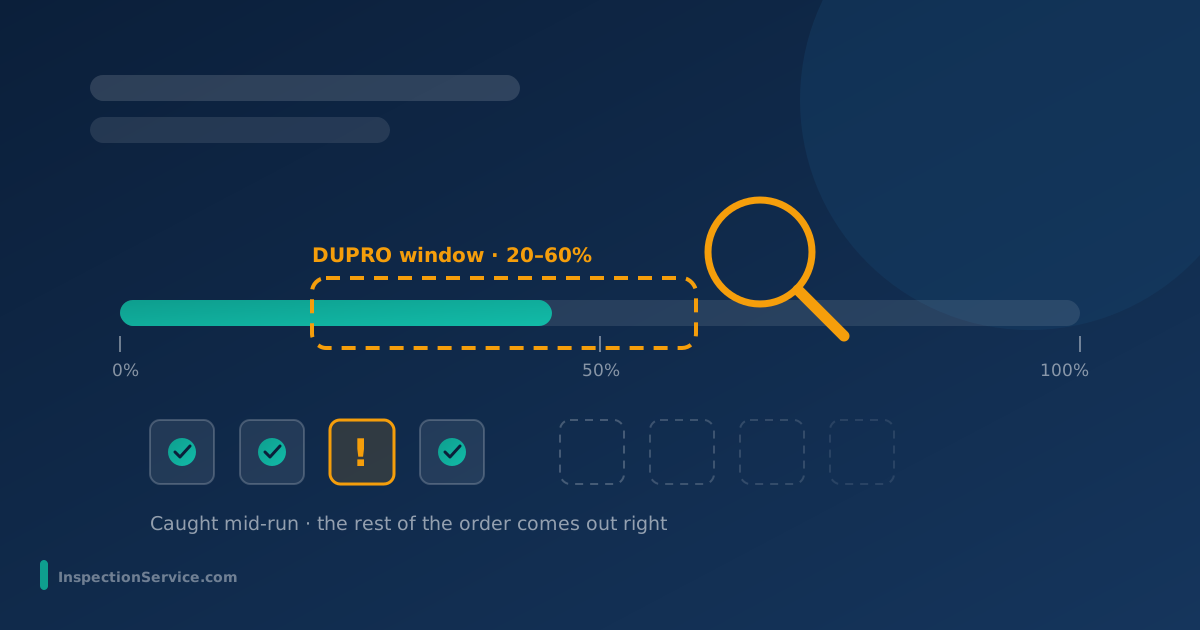
If you already know when a during-production inspection makes sense — we covered the timing question in DUPRO vs PSI — the next question is what you're actually buying when you book one. A DUPRO is the least understood of the three standard inspections. Buyers know a pre-shipment inspection is a pass/fail verdict on finished goods, and an Initial Production Check verifies inputs before the run starts. A DUPRO is neither: it's a diagnosis of a process in motion, and reading its report takes a slightly different mindset than reading a PSI.
This guide walks through the inspection itself: what the inspector does on-site, how sampling works when most of the order doesn't exist yet, what the report tells you that no other inspection can, and how to act on it while there's still time for acting to matter.
First, the names — DUPRO, DPI, IPI
The industry uses three names for the same visit: During-Production Inspection (DUPRO), During Production Inspection (DPI), and In-Process Inspection (IPI). Some providers treat “in-process inspection” as a slightly broader term that can include repeated in-line monitoring, but for a standard one-day mid-run check, all three names describe the same service. If a quote says any of them, you're comparing like with like.
The one number that defines a DUPRO: production completion
A DUPRO is typically booked when 20–60% of the order is complete — early enough that most of the run is still unmade, late enough that there's a real sample of actual production to judge. Book it too early (under ~10–20% done) and the inspector has too few finished units for meaningful sampling; too late (80%+) and you've effectively bought an early PSI with none of the corrective-action benefit.
What the inspector actually does on-site
A standard one man-day DUPRO covers five things:
- Production status count. Finished units, units in each stage of assembly, raw material stock — compared against the schedule your delivery date depends on.
- Raw material and component check. The materials feeding the rest of the run — fabric lots, resins, components, packaging stock — checked against your spec and approved sample. A substitution caught here affects only the unmade portion; caught at PSI, it's built into everything.
- AQL sampling of completed units. A random sample drawn from the units finished so far, inspected exactly like a PSI sample: workmanship against critical/major/minor defect classes, measurements against spec, function checks where applicable.
- In-line process review. The part no other inspection type includes: the inspector walks the live production line — assembly methods, workmanship at each station, in-house QC practices — looking for the causes of defects, not just the defects. A misaligned jig or an untrained station found here explains a defect trend and tells the factory exactly what to fix.
- Photo documentation. Line, materials, defects, and sampled units — the evidence base for the corrective-action conversation that follows.
How AQL works on a half-finished order
The sampling logic is the same AQL methodology as a PSI, with one adjustment: the “lot” is the quantity completed so far, not the full PO. If 3,000 of your 10,000 units are finished, the sample size comes from a lot of 3,000. That means:
- The result is a verdict on production so far — a projection, not a final acceptance decision. Final acceptance still belongs to the PSI.
- Because the mid-run lot is smaller, the sample is smaller, and the statistical resolution is coarser than your eventual PSI. That's fine — you're hunting for trends and systematic problems, not certifying the lot.
- A “fail” at DUPRO is not a shipment rejection. It's something more useful: a defect rate measured while 40–80% of your order is still unmade.
Reading a DUPRO report: trend, not verdict
A PSI report answers “ship or don't ship.” A DUPRO report answers “what will the rest of this run look like if nothing changes?” — which makes the pattern of defects more important than the count:
| Pattern in the defect log | What it means | What to do |
|---|---|---|
| Random, scattered minors across defect types | Normal process variation | Note them, confirm they're within your AQL, move on |
| A cluster of the same defect — same seam, same solder joint, same misprint | A process problem that will repeat in every unit until the line is corrected | The finding a DUPRO exists to catch — the report should connect it to what the inspector saw at the station causing it |
| Anything critical (safety, compliance, legal) | Stop-and-fix regardless of count | Halt, correct, verify before production continues |
The corrective-action window — where the money is
The value of a DUPRO isn't the report; it's what happens in the 24–72 hours after it. The sequence that works:
- Same-day report (24-hour turnaround is standard) goes to you and, with your go-ahead, to the factory.
- The factory corrects the line — the specific stations and processes identified, not a vague “improve quality” request. Specific findings get fixed; generic complaints get promises.
- The defective portion already produced gets segregated and reworked in parallel, while good production continues.
- You verify the fix — either a re-inspection at ~60–80% for larger orders, or simply at the PSI, where the defect classes flagged mid-run get extra attention.
Compare that with the same defect found at PSI: 100% of the order affected, rework happening against the shipping deadline, and the options narrowing to the ones in what to do when your inspection fails. The DUPRO version of the same problem costs a fraction as much — that's the entire economic case.
When a DUPRO earns its fee — and when it doesn't
At typical independent rates of $250–350 per man-day, a DUPRO doubles your inspection spend if you're also doing a PSI. It's clearly worth it for:
- Large orders, where mid-run correction protects the bulk of the quantity;
- New suppliers or new products, where you have no history telling you the process is stable;
- Process-sensitive products — garments, footwear, furniture, multi-step assembly — where workmanship drifts;
- Tight shipping windows, where a PSI failure would be unrecoverable and the production-status count alone justifies the visit;
- Post-holiday production runs (post-CNY in China, post-Tết in Vietnam), when workforces turn over and defect rates measurably rise.
Booking one: what to specify
A DUPRO brief needs everything a PSI brief needs — spec sheet, approved sample or golden sample reference, AQL levels, defect classification — plus two things unique to mid-run checks: the production milestone that triggers the visit (e.g., “when 30% of units are finished,” confirmed with the factory rather than assumed from the calendar) and what happens with the findings (who receives the report, whether the factory gets it directly, whether a re-inspection is pre-agreed if results are poor). The preparation checklist covers the rest.
The bottom line
A during-production inspection is the only standard QC service that inspects a process rather than a result. Its report is a forecast: what the rest of your order will look like if nothing changes — delivered while changing things is still cheap. Used on the right orders, with findings pushed into corrective action within days, it's the highest-leverage man-day in third-party QC.
Our marketplace connects you with vetted providers offering during-production inspections across 24 countries — compare free quotes matched to your product and factory location.
Frequently asked questions
Most are scheduled at 20–60% completion. Early in that range maximizes the corrective-action window; later gives a bigger completed lot to sample. For high-value orders, some buyers book two visits — one around 20–30% and one around 60%.
Usually it isn't — DUPRO, DPI, and IPI are interchangeable names for the same mid-production check with most providers. Some firms use “in-process inspection” for repeated or continuous in-line monitoring; if the scope matters to you, confirm the number of visits in the quote.
Yes — the same AQL methodology as a pre-shipment inspection, applied to the quantity completed at the time of the visit rather than the full order. The result is read as a trend indicator for the run, not a final acceptance decision.
No. At 20–60% completion, most of the order doesn't exist yet, and packing, final quantities, and finished-goods checks can't be verified. A DUPRO complements a PSI: catch process problems mid-run, confirm the finished lot before shipment.
The same as other man-day inspections — typically $250–350 per man-day from independent providers in most Asian manufacturing markets. Most DUPROs for consumer goods are a single man-day.
The report goes to you within about 24 hours. The standard sequence: the factory corrects the identified process issues, reworks the defective units already produced, and the fix is verified either at a follow-up inspection or at the pre-shipment inspection.