DUPRO vs PSI: When a Pre-Shipment Inspection Is Already Too Late
A PSI catches problems — but it can't undo them, because the goods are already made. The three checkpoints on a production timeline, what each can catch that the later ones can't, and the honest math on when an earlier inspection pays for itself.
Most importers book exactly one inspection: the pre-shipment inspection, a few days before the goods ship. For many orders, that is the right call. But a PSI has a built-in limitation that surprises buyers at the worst possible moment: by the time it happens, your product is already made.
If the fabric was wrong, it is wrong in 10,000 finished garments. If a moulding parameter drifted in week two, it drifted through the whole run. A PSI will catch the problem — that is its job — but it cannot undo it. Your options at that point are the ones we covered in what to do when your inspection fails: rework, sorting, concession, or rejection. All of them cost time you no longer have.
The fix is not a better PSI. It is inspecting earlier — sometimes. This guide explains the three main inspection points on a production timeline, what each one can catch that the later ones cannot, and the honest math on when adding an earlier check pays for itself.
The production timeline — and where each inspection sits
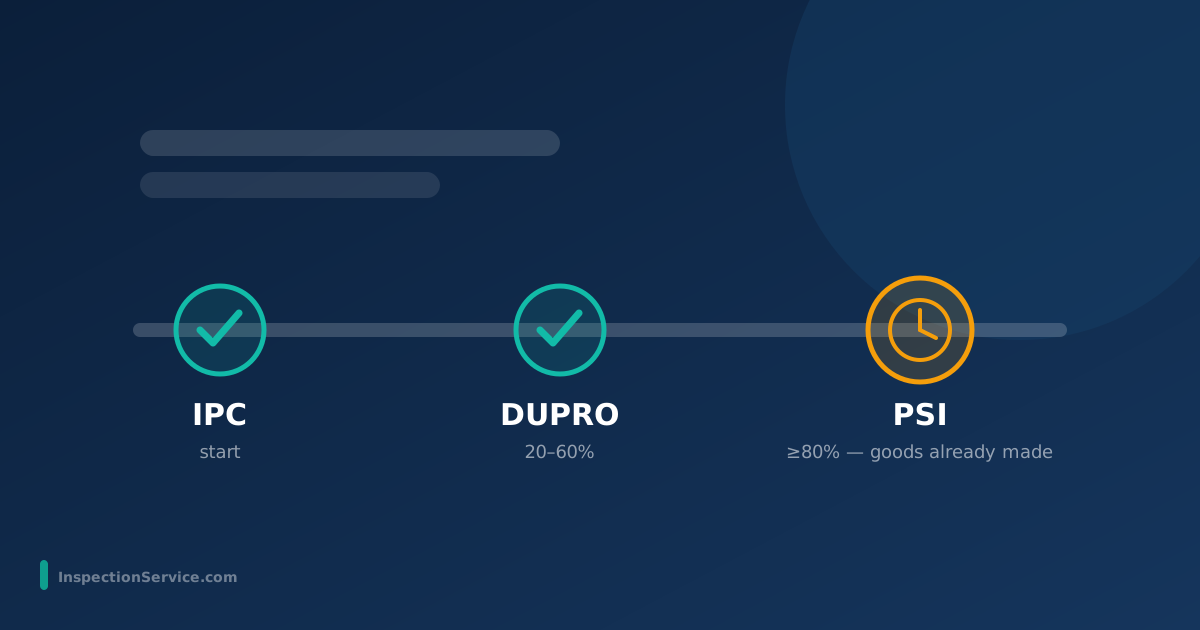
Think of your order as a timeline from raw materials to a loaded container. There are three standard places to put independent eyes on it:
Initial Production Check (IPC) — at the start. Materials are in place and the first units are coming off the line. The inspector verifies that the factory is starting with the right inputs: correct fabric, components, colours and materials against your approved sample, machinery set up, first outputs conforming. More on IPC →
During-Production Inspection (DUPRO) — mid-run, typically when 20–60% of the order is finished. The inspector pulls a random sample from actual production, checks it against your spec and AQL, and flags process defects while most of the order is still unmade. More on DUPRO →
Pre-Shipment Inspection (PSI) — when at least 80% is finished and packed. The final verdict on the lot you are about to pay the balance on and ship: workmanship, function, measurements, packaging, quantities. More on PSI →
Same inspector skill set, same AQL logic, roughly the same cost per visit. The only variable is when — and timing determines what is still fixable.
What each inspection can catch that the later ones can't
| Check | Unique catch | If found here | If found at PSI instead |
|---|---|---|---|
| IPC | Wrong or substituted materials, outdated artwork, bad setup | A purchasing correction before units exist | An entire order made of the wrong input — rework can't fix raw materials |
| DUPRO | Process defects: stitching, soldering, alignment, print drift | Line corrected; remaining 60–80% comes out right | Whole-order rework against the shipping clock |
| PSI | Finished-goods verdict: quantities, packing, barcodes, drop test, final AQL | Ship with confidence | — (nothing later; after this it's your warehouse) |
Only an IPC can catch input problems before they multiply. A wrong-shade fabric, a cheaper substitute component, an outdated artwork file — at the start of production these are a purchasing correction. At the PSI they are 10,000 defective units. Material substitutions are among the most expensive defects to discover late, because no amount of rework fixes the wrong raw material.
Only a DUPRO catches process defects while the process is still running. Stitching tension, solder quality, assembly alignment, print registration — these drift during production. Found at 30% complete, the factory corrects the line and the remainder comes out right; the defective portion is small enough to rework in parallel, with zero impact on your ship date. A DUPRO also gives you something subtle but valuable: proof of the factory's real production pace. "We're at 50%" claims get verified by someone physically counting.
Only a PSI can judge the finished, packed order. No early inspection replaces it: final quantities, export packing, carton markings, barcodes, the drop test, and the overall AQL verdict on completed goods only exist at the end. This is why a DUPRO complements rather than replaces a PSI — and why skipping the PSI because "the DUPRO looked fine" defeats the point.
The honest cost math
Each inspection visit costs roughly the same — typically $200–$500 per man-day, depending on country and provider. So adding a DUPRO roughly doubles your inspection spend on the order. When is that worth it?
Add an IPC and/or DUPRO when:
- It's a first order with a new supplier. You have no track record; the cost of discovering their real quality level at the PSI is highest here. This is the single most common scenario where buyers under-inspect.
- The order is large or long-running. A 6–8 week production run gives defects weeks to repeat. On a $150,000 order, a $300 mid-run check is 0.2% of order value insuring the other 99.8%.
- The product is defect-prone or complex. Garments with heavy construction, multi-component electronics, anything with printing, plating or colour-matching.
- The deadline is unmissable. Seasonal goods, marketplace launch dates, retail delivery windows. Late defect discovery plus a hard deadline is exactly the trap the failed-inspection playbook exists for. Early checks are how you stay out of it.
- You've had problems with this supplier before. A previous fail is a documented reason to move your checkpoint earlier, not just to re-inspect harder at the end.
A PSI alone is usually enough when:
- It's a repeat order of an unchanged product from a supplier with a clean inspection history.
- The order is small, simple and low-risk — the cost of a second visit approaches the value of the goods at stake.
- Production time is short (a week or two), leaving little room for mid-run drift.
The classic mistake: one PSI on a first order
Put the two lists together and one scenario stands out: the first order from a new factory, protected by nothing but a PSI. It is the most common inspection setup among small importers — and the riskiest, because it stacks maximum uncertainty (unknown supplier) against minimum reaction time (goods finished, deadline near).
For deeper supplier risk — before any PO is placed — that is what factory audits are for: an audit checks the factory, inspections check your goods.
Booking logistics: one provider, one brief
You do not need separate arrangements for each check. Any serious inspection company offers IPC, DUPRO and PSI as standard services — book them as a package on the same order, with the same specification, the same AQL plan, and ideally the same inspector. The DUPRO brief should explicitly carry forward anything the IPC flagged; the PSI brief should verify anything the DUPRO corrected. Three visits, one continuous quality narrative — not three isolated reports.
A pre-shipment inspection tells you the truth about your order. Inspecting earlier changes what that truth can be. Match your checkpoints to your uncertainty, and most of the failed-inspection playbook becomes something you read once and never need.
Frequently asked questions
DUring PROduction inspection — also called an in-process or during-production inspection. It is carried out mid-run, typically when 20–60% of the order is finished, using the same AQL sampling logic as a pre-shipment inspection.
No. A DUPRO catches process problems while they are still cheap to fix, but only a PSI can verify the finished, packed order — final quantities, packaging, barcodes and the overall AQL verdict. On orders that justify a DUPRO, they work as a pair.
When enough production is finished to sample meaningfully but enough remains to benefit from corrections — commonly 20–60% complete. Earlier in that window for long runs and risky products; your inspection company will confirm timing with the factory.
Essentially the same as a PSI — most providers charge per man-day, typically $200–$500 depending on the country. The sampling work is similar; only the timing differs.
Usually only when the input risk is high — custom materials, colour-critical products, or a supplier you have never used. For small orders of standard goods, most buyers put their single inspection at pre-shipment, or at DUPRO if the timeline is tight.