What Is a Pre-Shipment Inspection? A Complete Guide
The pre-shipment inspection is the last chance to catch a quality problem while it's still the factory's problem — before you pay the balance and before the container leaves. Here's exactly how it works, when to book it, what the inspector checks, and how to read the result.
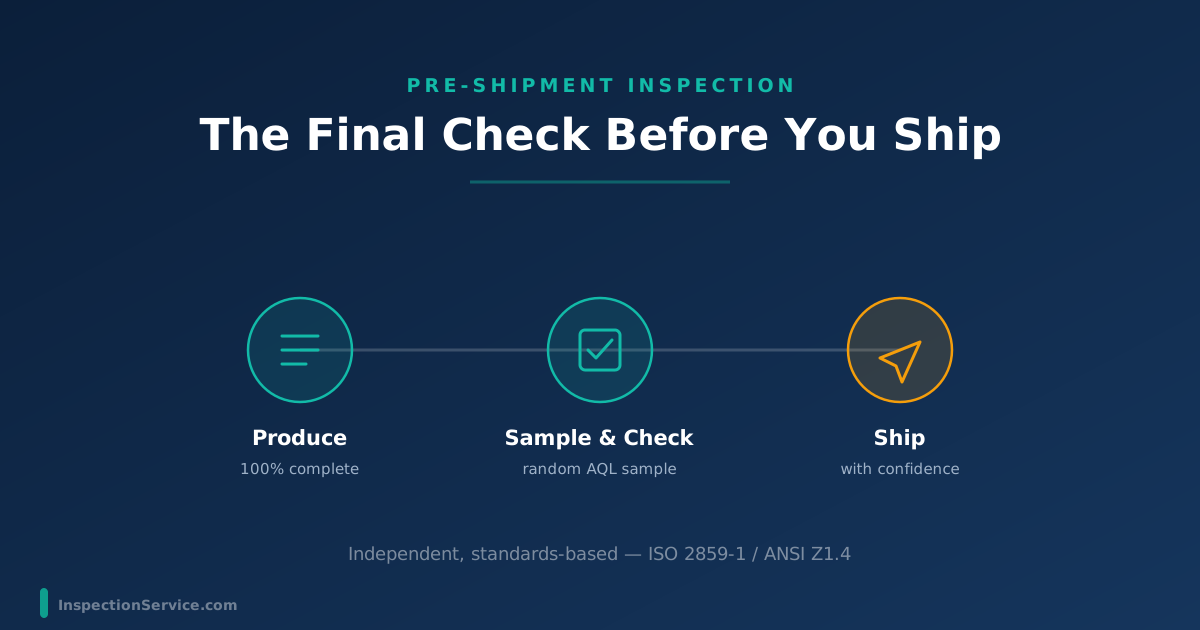
A pre-shipment inspection (PSI) — also called a final random inspection (FRI) — is a quality check carried out on your finished goods before they leave the factory. An independent inspector visits the production site, pulls a random sample of the packed goods, and checks them against your requirements. You get a report, usually within 24 hours, telling you whether the order is ready to ship.
It's the single most common inspection buyers book, because it sits at the highest-leverage moment in the whole order: production is done, but you still hold the balance payment and the goods are still in the factory's hands.
Why a pre-shipment inspection matters
By the time goods are finished, most of your leverage has already been spent — except for two things: the balance payment you haven't released yet, and the fact that the goods are still with the supplier. A PSI turns both into leverage. If the inspection finds a problem, it's far cheaper and faster to fix it at the factory than to discover it when the container is opened in your warehouse, thousands of miles and several weeks later.
When is a pre-shipment inspection done?
A PSI is scheduled when production is 100% complete and at least 80% packed. This isn't arbitrary. If the inspector arrives too early, there aren't enough finished, packed units to draw a representative random sample from — and a sample that isn't random isn't statistically meaningful. Booking at 80%+ packed lets the inspector select units across the whole production run, not just the first cartons off the line (which factories, understandably, tend to make their best).
Practically, you book the inspection a few days in advance and coordinate the date with your supplier, who confirms when the goods will be ready. Most providers need one to three days' notice.
What does the inspector actually check?
A PSI is broader than most buyers expect. It's not just "look at the product" — it covers quantity, quality, conformity and packaging. The exact checkpoints depend on your product category (see our apparel and electronics guides for category-specific detail), but a standard PSI always covers:
| Area | What the inspector verifies |
|---|---|
| Quantity | Number of finished, packed units against the order — the most basic and most commonly wrong figure. |
| Workmanship & defects | Each sampled unit is examined for defects, which are recorded as critical, major or minor and judged against your AQL. |
| Conformity to specification | Product matches your approved sample, tech-pack and spec — colour, material, construction, components. |
| Measurements & function | Key dimensions checked against tolerances; on-site function or safety tests where applicable. |
| Labeling & barcodes | Care labels, country of origin, retail and shipping marks, and scannable barcodes. |
| Packaging | Retail and export packaging, carton markings, and often a carton drop test to check shipping durability. |
How the sampling works
The inspector doesn't check every unit — that would be slow and expensive. Instead they check a statistically valid random sample defined by ISO 2859-1 (ANSI/ASQ Z1.4) and your chosen AQL (Acceptable Quality Limit). The AQL sets how many defects are tolerable in the sample before the whole lot is rejected. Lower AQL = stricter = larger sample and fewer defects allowed.
The common setup for general consumer goods is AQL 0 for critical, 2.5 for major, and 4.0 for minor defects. If you want to see exactly how your order quantity and AQL translate into a sample size and accept/reject numbers, use our free AQL sample size calculator — and read Critical, Major & Minor Defects Explained to understand how defects get classified in the first place.
Where a PSI fits among the inspection types
The pre-shipment inspection is one of several checks across the production timeline. Each catches problems at a different stage:
| Inspection | When | Catches |
|---|---|---|
| Initial Production Check (IPC) | Before / at start of production | Wrong materials or components before they're built in |
| During Production (DUPRO) | ~20–60% produced | Systematic problems early enough to correct the run |
| Pre-Shipment (PSI / FRI) | 100% produced, 80%+ packed | The final, overall quality verdict before shipment |
| Container Loading Check (CLC) | At loading | Right goods, right quantity, loaded and secured correctly |
For higher-value or higher-risk orders, buyers often combine a DUPRO with a PSI so problems are caught early and confirmed fixed at the end. But if you only do one inspection, the pre-shipment inspection is the one to do.
What you need to give the inspector
An inspection is only as good as the reference it's measured against. To get a meaningful result, provide:
- Your specification / tech-pack / drawings — what the product should be
- An approved (golden) sample where possible — the physical benchmark
- Your defect classification list — what counts as critical, major, minor
- Your sampling plan / AQL — how strict the check should be
- The packing list and any retail/shipping mark artwork
Not sure how to assemble these? Our upcoming AI report-template builder auto-detects the inspection type, product, SKUs and sampling plan straight from documents like these — or you can build a template manually. Join the early-access list on our Resources hub.
How to read the result
A PSI report concludes with a result — typically Pass, Fail, or Pending/Hold — plus the defect counts against each AQL, measurement and function data, and photographs. A "fail" doesn't necessarily mean scrap: it means the lot didn't meet the agreed standard, and you now have documented leverage to require rework, re-inspection, a discount, or a hold on shipment before you release payment.
The report is only useful if it's complete and accurate. A surprising number aren't — missing photos, defects that don't reconcile with the AQL result, or checkpoints skipped. Learn what to watch for in Can You Trust Your Inspection Report?
What does a pre-shipment inspection cost?
Most providers price by the man-day — the work one inspector completes in a day — typically in the region of US$240–$320 depending on country and provider, with one man-day covering many standard orders. For a full breakdown, see How Much Does a Pre-Shipment Inspection Cost?
The bottom line
A pre-shipment inspection is the highest-value, lowest-cost insurance an importer can buy: an independent, standards-based check at the exact moment you still hold both the money and the goods. Set your specification and AQL clearly, book at 80%+ packed, and read the report carefully — that's most of the job done.
Frequently asked questions
Yes. "Pre-shipment inspection" (PSI) and "final random inspection" (FRI) refer to the same check — a random, AQL-based inspection of finished goods once production is complete and at least 80% packed. Different providers simply prefer different names for it.
Book it once production is 100% complete and at least 80% of the goods are packed, and before you release the balance payment. This ensures the inspector can draw a representative random sample and that you still have commercial leverage if a problem is found. Give the provider one to three days' notice.
A fail means the lot didn't meet the agreed AQL standard. It rarely means the goods are worthless. With a documented report in hand you can require the supplier to rework and re-inspect, negotiate a discount, sort out the good units, or hold shipment until the issue is resolved — all before you pay the balance.
Yes, though each SKU is usually sampled and judged separately against the AQL, and a large number of SKUs or a big order quantity may require more than one man-day. The provider will estimate the man-days needed based on your SKU count, order quantity and inspection level.
An independent PSI is valuable even with a trusted supplier. A factory's own QC has an inherent conflict of interest, sub-suppliers and materials change between orders, and a neutral, standards-based report protects both sides if a dispute arises later. It's insurance, not an accusation.