Electronics Inspection: Checklist & Standards
With electronics, a product can look flawless and still be a return waiting to happen. That's why an electronics inspection leans heavily on function and safety testing. Here's a complete pre-shipment checklist for consumer electronics and small appliances.
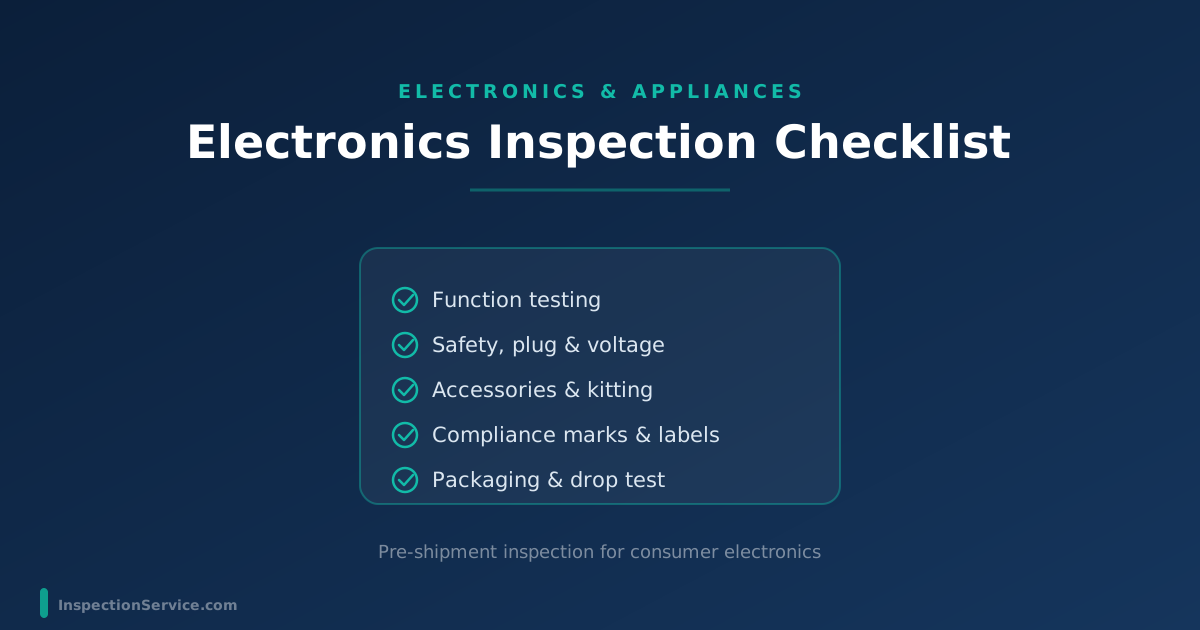
This is a category-specific companion to our complete guide to pre-shipment inspections. For electronics and appliances, the general PSI framework holds — but the emphasis shifts. Cosmetic checks matter, but the checkpoints that actually prevent returns are function, safety and power, because a defect there is invisible until the customer plugs it in.
1. Quantity, model & conformity
The inspector confirms packed quantity against the order, and that the exact model, variant and configuration match your spec and approved sample — right board revision, right firmware where checkable, right colour and finish. With electronics, a subtle model or component substitution is a real risk.
2. Function testing
This is the heart of an electronics inspection. Each sampled unit is powered on and put through its core functions against a defined test procedure: it turns on, all buttons/ports/modes work, screen and indicators behave, connectivity (Wi-Fi/Bluetooth/pairing) works, battery charges and holds, and there are no abnormal noises, smells or heat. For safety-critical products, function testing is often applied to 100% of units, not just the AQL sample.
3. Safety & electrical checks
The inspector verifies the field-checkable safety essentials against your spec and destination-market requirements:
- Plug type and voltage correct for the destination market (a US plug on an EU-bound order is an instant fail)
- Cables, connectors and strain relief intact; no exposed conductors
- Required safety markings present (e.g. CE, UKCA, FCC, or the relevant mark for your market) and matching the certified model
- Basic high-voltage / earth-continuity checks where the procedure and equipment allow
Note: full electrical safety certification (the lab test behind a CE or UL mark) is a separate lab process. The inspection verifies the marks are present and the obvious safety features are correct — it doesn't re-certify the product.
4. Accessories, kitting & completeness
Electronics ship as kits, and missing or wrong accessories are a top complaint. The inspector checks that every unit contains the full bill of accessories — correct charger/adapter, cables, remote (and batteries), manuals in the right languages, warranty card — and that nothing is mismatched between boxes.
5. Cosmetic & workmanship defects (graded by AQL)
Sampled units are also inspected for cosmetic and build defects — scratches, gaps, misaligned parts, poor moulding, loose components — recorded as critical, major or minor against your AQL:
| Class | Typical electronics examples |
|---|---|
| Critical | Exposed live conductor, overheating, wrong voltage/plug for market, missing mandatory safety mark |
| Major | Unit won't power on, key function fails, missing charger, cracked screen, wrong model |
| Minor | Light scratch, small cosmetic blemish, slightly loose panel, minor manual misprint |
Critical stays at AQL 0; major/minor are commonly 2.5/4.0. Model your own sample size with the AQL calculator.
6. Labeling, barcodes & documentation
The inspector verifies rating labels (voltage, power, model), serial numbers, safety and compliance marks, energy labels where required, retail barcodes (present and scannable), and that included documentation matches the model and destination market.
7. Packaging & drop testing
Electronics are fragile and travel far, so packaging is a checkpoint in its own right: correct retail box and inserts, adequate protective packaging, accessories secured, and export cartons that survive handling. A carton drop test is standard, and for fragile items the inspector checks the protective design actually holds the product in place.
Electronics pre-shipment checklist at a glance
| Checkpoint | Verify |
|---|---|
| Quantity & model | Packed qty vs order; exact model/variant vs spec |
| Function test | Power-on, all functions, connectivity, battery — per procedure |
| Safety & electrical | Plug/voltage for market, cables, required safety marks |
| Accessories | Complete kit: charger, cables, manual, warranty |
| Cosmetic / workmanship | Defects graded critical/major/minor vs AQL |
| Labeling | Rating label, serial, compliance marks, scannable barcode |
| Packaging | Retail box, protection, carton drop test |
Grab our free, downloadable Electronics & Appliances PSI template & checklist — the full checkpoint list, ready to edit in Word. Our AI template builder can also generate a function-test template tailored to your product from its spec sheet, and our electronics quality control page covers the category.
Frequently asked questions
Cosmetic and workmanship checks use an AQL sample, but function testing is often applied to a larger share of units — and for safety-critical products, frequently 100% — because a functional or safety defect is far more costly than a cosmetic one. You define the test coverage in your inspection procedure.
No. Certification marks like CE, UKCA or UL come from formal laboratory testing of the product design, done separately. A pre-shipment inspection verifies that the required marks are present and correct on the production units and that obvious safety features are intact — it does not certify the product.
Function failures and missing or wrong accessories top the list, followed by wrong plug/voltage for the destination market. These are exactly the defects a visual-only check misses, which is why a defined function-test procedure is essential for electronics.
Yes — the more specific your function-test steps, the more reliable the result. Provide the sequence of functions to check, expected outcomes, and any pass/fail thresholds. If you don't have one, an experienced electronics inspector applies a standard procedure, but a product-specific test catches more.
For electronics, yes — they're complementary. Lab testing (done earlier, on samples) proves the design is safe and compliant; the pre-shipment inspection proves the mass-produced units actually work and match that approved design. Relying on only one leaves a gap.