Factory Audits in Bangladesh: What Garment Buyers Need to Check
In Bangladesh, a factory audit is usually the price of entry. Which audits to run, in what order, and how to tell a factory that meets the standard from one that has learned to look like it does.
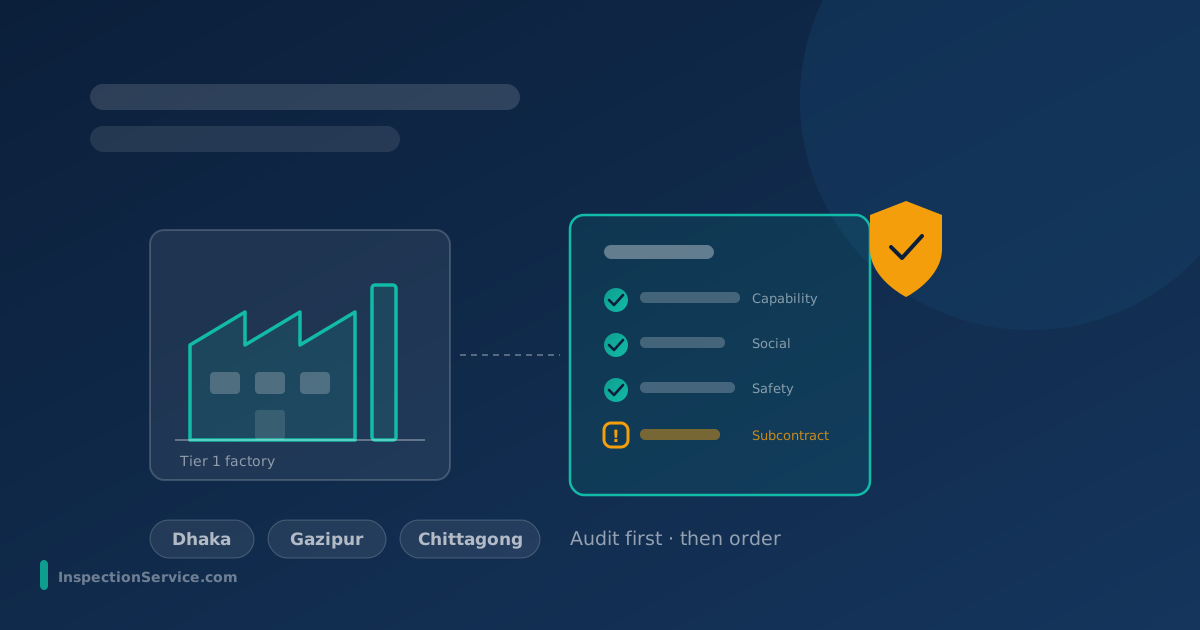
In most sourcing countries, a factory audit is good practice. In Bangladesh, it's usually the price of entry. The country is the world's second-largest garment exporter after China — ready-made garments make up over 80% of its exports and employ more than 4 million workers. That scale comes with a history every Western retailer knows: since the Rana Plaza collapse in 2013, building safety, fire safety and labour conditions in Bangladeshi factories have been under closer scrutiny than almost anywhere else.
So the question for a buyer is rarely whether to audit a Bangladeshi supplier. It's which audits to run, in what order — and how to tell a factory that genuinely meets the standard from one that has learned to look like it does.
This guide covers which audits matter in Bangladesh, the building-safety system that grew out of Rana Plaza, the subcontracting risk, costs and timing, and how to choose an audit provider on the ground. For general Bangladesh sourcing and inspection services, see our Bangladesh quality control page.
Why Bangladesh is audit-first
Every sourcing market rewards due diligence, but three things make audits more central in Bangladesh than in most:
1. Your customers will ask. Most Western brands and retailers expect social compliance (typically BSCI or SMETA) and factory-safety compliance before orders begin. If you sell to retail, the audit is often a contractual requirement, not a choice.
2. The gap between tiers is wide. Quality and compliance vary enormously between Tier 1 factories supplying major brands directly and the Tier 2 and Tier 3 subcontractors behind them. Two factories in the same district can be a world apart.
3. Unauthorised subcontracting. Orders quietly moved from the factory you approved to an unvetted subcontractor are a known risk in Bangladesh's dense garment clusters. When it happens, every audit you ran on the original factory stops being relevant to your goods.
Which audit, for what question
Audits answer different questions — the full taxonomy is here — but for a Bangladeshi garment supplier, four matter most:
| Audit | The question it answers | When |
|---|---|---|
| Capability & quality | Is this factory real, and can it make my product, at my volume, to my standard? | Before the first PO — the default first audit |
| Social compliance (BSCI / SMETA / SA8000) | Does this factory meet the labour standards my market demands? | Usually before orders begin; your customer dictates the scheme |
| Building & fire safety | Is the building itself — structure, fire systems, electrics — safe? | Before onboarding; check remediation status |
| Environmental | Will this factory create environmental or regulatory exposure? | Dyeing, washing and finishing operations |
A social audit and a building-safety inspection are not the same thing: one looks at people and practices, the other at structural engineering. In Bangladesh, buyers usually need both. Which social scheme you need depends on who's asking — here's how BSCI, SMETA and SA8000 differ. To book any of these, see our factory & supplier audit service.
Building safety: the Accord, the Alliance and the RSC
After Rana Plaza, two brand-led programs — the Accord and the Alliance — inspected garment factories for structural, fire and electrical safety and monitored their remediation. In 2020, the Accord's operations in Bangladesh were handed over to the RMG Sustainability Council (RSC), a national body governed equally by industry, brands and trade unions. The RSC continues factory safety inspections and remediation monitoring.
The subcontracting problem, specifically
Unauthorised subcontracting undermines everything else on this list. A factory can pass a capability audit, a social audit and a safety review — then move part of your order to a smaller workshop to meet a deadline. Your goods end up made somewhere nobody has assessed.
An audit helps in two ways. First, it establishes real capacity: if a factory's lines, machinery and headcount can't plausibly produce your volume in your timeframe, the order is going somewhere else. Second, it creates a baseline for spot checks: once you know what the factory looks like, an in-process inspection during production can confirm your order is actually on those lines.
Write a no-subcontracting-without-approval clause into your purchase orders as well. The audit gives you the evidence; the clause gives you the right to act on it.
Where the factories are
Bangladesh's garment and textile production concentrates in a few clusters — and where your supplier sits affects audit logistics, travel costs and which providers can reach them quickly.
Dhaka and its industrial belt (Gazipur, Savar, Ashulia, Narayanganj, Tongi): the core of the garment industry, with the densest supplier base and the densest subcontracting networks.
Chittagong: the country's main port in the south-east, with its own garment and export-processing base.
Bangladesh isn't only garments: leather, footwear, jute goods, home textiles and pharmaceuticals are also significant. The audit types are the same — but make sure the auditor has experience in your category, and confirm coverage before booking if your supplier sits outside the main clusters.
Costs and timing: what's realistic
Product inspections in Bangladesh typically run about $200–$325 per man-day, comparable to other major Asian sourcing countries (the cost logic explained here). Audits are priced higher: they need more senior auditors, more preparation and a longer report — and scheme audits such as BSCI, SMETA or SA8000 cost more again, because the audit firm must be approved for the scheme. How many man-days an audit takes depends on the audit type, the scheme and the size of the factory and workforce, so ask providers to quote for your specific factory and scope rather than comparing day rates alone.
Timing: production pauses around both Eid holidays, whose dates move each year with the lunar calendar. Audits are harder to schedule in those windows, and production around them is often compressed. Confirm the factory's holiday calendar and build in a buffer.
How to vet an audit provider in Bangladesh
Whichever tier of provider you use — global TIC firm or local independent — apply the same checks:
- Auditor location and language. Bangladesh-based auditors who speak Bangla — worker interviews in a social audit are only as good as the auditor's ability to talk to workers directly.
- Scheme approval where it matters. For BSCI, SMETA or SA8000, the firm and auditor must be approved for that scheme. Not every inspection company is.
- A sample report. Look for photos, specific findings and a corrective action plan with deadlines — not just a score. The same red flags as for inspection reports apply.
- Independence. The auditor works for you, not the factory. Be wary of providers arranged or paid by the supplier.
After the audit: findings are normal
First audits of Bangladeshi factories often produce findings — especially on working hours, documentation and fire-safety details. A finding isn't automatically a reason to walk away. What matters is how the factory responds: a credible corrective action plan, real deadlines and a follow-up audit to verify the fixes. A supplier that engages seriously with findings is often a better long-term partner than one that claims a perfect record.
The bottom line
Start with a capability audit to confirm the factory is real and right for your product. Add the social compliance scheme your customers require. Ask about building-safety status and the RSC. And watch for subcontracting once production starts.
Compare free quotes from vetted audit providers in Bangladesh — local auditors in Dhaka, Gazipur, Chittagong and the other main clusters.
Frequently asked questions
For most Western buyers, yes. Brands and retailers typically require social compliance (BSCI or SMETA) and factory-safety compliance before orders begin, and a capability audit is the standard way to verify a new supplier.
The RMG Sustainability Council is a national body that took over the Accord's factory-safety operations in Bangladesh in 2020. It's governed by industry, brands and trade unions, and continues building, fire and electrical safety inspections and remediation monitoring.
A social audit covers labour practices: wages, working hours, child and forced labour, health and safety, and worker treatment. A building-safety inspection covers the structure, fire systems and electrical installations. In Bangladesh, buyers usually need both.
Audits are priced above product inspections, which typically run about $200–$325 per man-day in Bangladesh. Scheme audits such as BSCI, SMETA or SA8000 cost more again. Total cost depends on the audit type, the scheme and the size of the factory, so ask for a quote for your specific scope.
Combine three things: a capability audit to confirm the factory has the capacity for your order, a no-subcontracting clause in your purchase order, and an in-process inspection during production to confirm your goods are on the approved lines.
Around the two Eid holidays, whose dates move each year with the lunar calendar. Production pauses, and the weeks before are often compressed. Confirm the factory's calendar and plan around it.