How to Choose an Inspection Company in Taiwan
In China, choosing an inspection company is a problem of abundance. In Taiwan the question flips: not whether an inspector can reach your factory — whether they can genuinely judge the high-spec product in front of them.
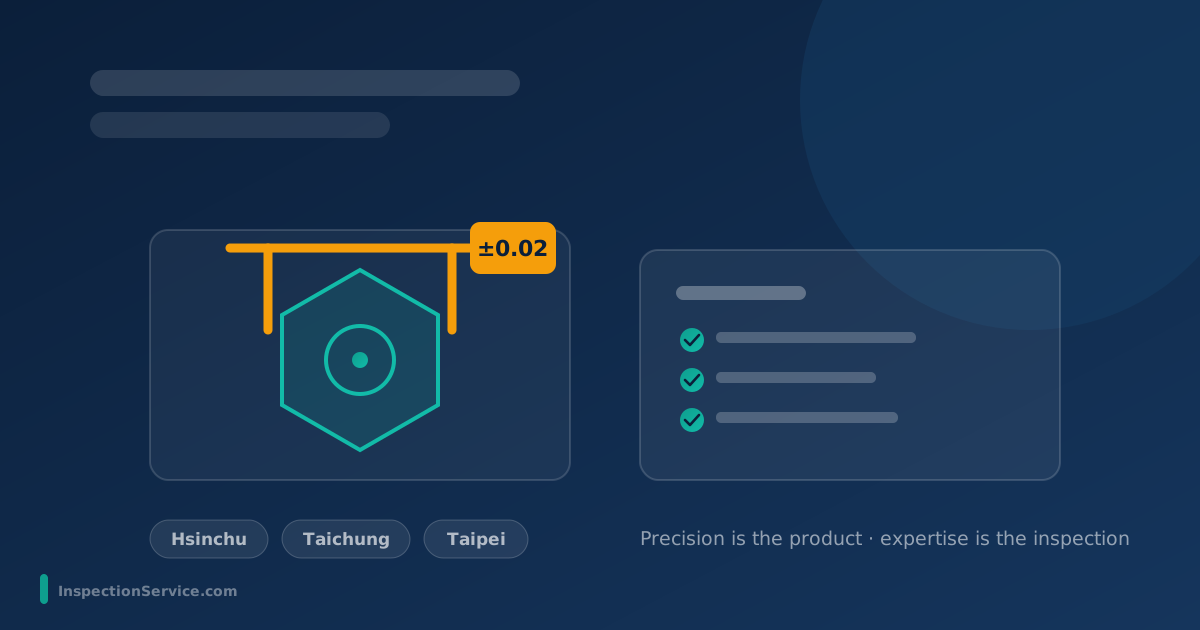
Choosing an inspection company in China is a problem of abundance — thousands of providers competing for every booking. Taiwan flips the question: it's almost never whether a provider can get an inspector to your factory — it's whether that inspector can genuinely judge the product in front of them. Taiwan doesn't make cheap goods. It makes semiconductors, precision machine tools, premium bicycles, fasteners engineered to demanding tolerances, and medical devices. A generalist inspector with a consumer-goods checklist can walk a Taichung machine-tool factory and miss everything that matters.
This guide covers who actually inspects in Taiwan, the technical-depth screening that separates providers here, what inspections cost in a premium market, and the Taiwan-specific details — clusters, certifications, timing — that shape a booking.
Taiwan's quality paradox: excellent factories, still worth inspecting
Taiwanese manufacturing is among the best in Asia — decades of R&D investment, a highly skilled workforce, strong IP protections, and companies that serve as the technical manufacturing partners behind major global brands. So why inspect at all?
Because the products are specification-critical. When a $2 garment is 2% off-spec, you discount it. When a machined component is 0.02 mm off-spec, it doesn't fit — and when a bicycle fork fails, someone gets hurt. Taiwan's defect rates are low; the cost per defect is among the highest in Asia. Independent verification in Taiwan is less about catching careless factories and more about confirming that technically demanding requirements — dimensional tolerances, material certifications, electrical safety, compliance marking — were actually met.
Who actually inspects in Taiwan
| Provider type | Strengths | Ask about |
|---|---|---|
| Global TIC firms | Taiwan offices near Taipei and the science parks; accredited lab testing attaches to the inspection; the default for regulated categories (medical devices, semiconductors under customer mandate) | Day rates and whether your order size gets senior attention |
| Regional firms (Greater China network) | Competitive rates, professional reporting, familiar booking process | Is the inspector based in Taiwan, and experienced in my category? A fly-in generalist is exactly the mismatch Taiwan punishes |
| Local Taiwanese specialists | Deep single-domain expertise — metrology, electronics testing, machinery, bicycle components — often with the right instruments in-house | English reporting quality and report verifiability |
The technical-depth checklist
Beyond the universal checks (verifiable ISO 17020 accreditation, independence from your supplier, AQL fluency), Taiwan adds:
- Instruments and metrology. For precision products, ask what measurement equipment the inspector carries or can access — calipers and a tape measure don't verify machine-tool tolerances. Serious providers can discuss CMM access, gauge calibration, and measurement reports without hesitation.
- Category-matched inspectors. Electronics inspections need hi-pot, function and safety-mark checks — our electronics checklist covers the full list; bicycles need torque, alignment and safety-critical component verification; fasteners need material certs traced to mill test reports. Ask who inspects, not just whether they can.
- Standards literacy for your destination market. CE/UKCA, FCC, RoHS/REACH, FDA for medical — Taiwanese factories export everywhere, and your inspector should read compliance marking and documentation as fluently as the factory's QA manager.
- Audit capability. For new supplier relationships, a factory & supplier audit matters more in Taiwan than in volume markets — you're often buying engineering capability, not just capacity.
Where your factory is: the clusters
Taiwan is compact — nothing is more than a few hours from Taipei — so coverage surcharges are modest. But the clusters tell you what expertise is nearby:
- Hsinchu Science Park: semiconductors, IC design, displays. Inspection here usually means audits, compliance and packaging verification rather than classic AQL sampling.
- Taichung / Changhua: machine tools, precision machinery, bicycles and components, fasteners. The heart of Taiwan's metalworking — and where dimensional inspection capability matters most.
- Greater Taipei / Taoyuan: ICT, electronics assembly, consumer goods. The densest inspector coverage.
- Tainan / Kaohsiung: petrochemicals, plastics, metal products, and newer semiconductor fabs in the south.
What it costs
Expect a premium over volume hubs. Where a standard consumer-goods PSI in a volume hub like Vietnam or Cambodia sits in the typical $250–350 man-day range, Taiwan bookings — especially those needing specialist instruments or category expertise — tend toward the upper end of that range and above. The premium mirrors the market: higher wages, higher skill, higher-spec products. Against the value of a specification-critical order, it remains one of the smallest line items in the shipment.
One cost note specific to Taiwan: because defect cost is high and order values often are too, buyers more frequently combine services — an initial factory audit for new suppliers, then PSI on early orders, relaxing to skip-lot inspection as history builds. Ask providers whether they support that progression rather than selling every shipment the same package.
Timing
Taiwan observes Chinese New Year on the same calendar as the mainland — late January to February — with a comparable shutdown and the same pre-holiday production compression. Book inspections one to two weeks ahead in that window. Taiwan's October 10 National Day is a short holiday, not a CNY-scale shutdown, but typhoon season (roughly July–September) occasionally disrupts site visits and shipping schedules in ways worth building a buffer for. The preparation checklist covers what to send your provider once the date is set.
The bottom line
In Taiwan, you're not screening out bad providers so much as matching the right expertise to a demanding product. The formula: verifiable accreditation, an inspector genuinely based in (or experienced with) Taiwan, a sample report in your category, real measurement capability for precision products, and standards literacy for your destination market. Get those five right and Taiwan is one of the lowest-risk, highest-quality sourcing decisions in Asia.
Our marketplace connects you with vetted inspection and audit providers in Taiwan — compare free quotes matched to your product category and factory location.
Frequently asked questions
For specification-critical products, yes. Taiwan's defect rates are low, but the cost per defect — a mis-machined component, a failed safety part, a wrongly-marked electronic device — is among the highest in Asia. Inspection in Taiwan is verification of demanding specs, not policing of careless factories.
Expect the upper end of the typical $250–350 man-day range and above, particularly where specialist instruments or category expertise are needed. Global TIC firms and accredited lab testing cost more.
Effectively yes — the island is compact and well-connected. The real question is expertise match: Hsinchu for semiconductors, Taichung/Changhua for machinery and bicycles, greater Taipei for electronics. Confirm your inspector has experience in your category, not just a nearby address.
Beyond workmanship and AQL sampling: function testing, hi-pot/electrical safety checks, compliance marking verification (CE/UKCA, FCC, RoHS), barcode and labelling checks, and packaging/drop testing where relevant.
Often it's a self-declaration rather than independent notified-body testing. Ask for the technical file or test reports behind the marking, and have your inspector verify that goods and labelling match what the certification actually covers.
Around Chinese New Year (late January–February), which Taiwan observes with a full shutdown like the mainland — production is compressed before it and restarts with turnover after. Typhoon season (July–September) can also disrupt inspection visits and shipping schedules.