How to Choose a Pre-Shipment Inspection Company in Cambodia
There is no single "best" inspection company in Cambodia — there's the right one for your product, your factory's location and your budget. The three tiers of the market, the checklist that sorts them, and the Cambodia-specific pitfalls to know before booking.
Cambodia has quietly become one of Asia's most important sourcing stories. Garment, footwear and travel-goods exports hit roughly $15.5 billion in 2025, up almost 16% year on year — with footwear alone growing 24.5%. Around 1.2 million workers across some 2,000 export factories now produce for Western brands, and new investment keeps arriving.
Which is why more buyers every month are typing some version of the same search: "best pre-shipment inspection company in Cambodia."
Here's the honest answer up front: there is no single "best" — there's the right company for your product category, your factory's location, and your budget. A footwear specialist with inspectors in Phnom Penh is the wrong choice for machinery in Sihanoukville, and the world's biggest TIC firm may be overkill for a $20,000 garment order. This guide covers what the Cambodian inspection market actually looks like, the criteria that separate good from bad, and the Cambodia-specific pitfalls to check before you book.
Why inspection matters more in Cambodia than buyers expect
Cambodia's factory base is real and growing fast — but it's young. Much of the export capacity was built in the last decade, a large share of factories are foreign-owned subsidiaries (Chinese, Korean and Japanese investment dominates recent projects), and quality systems vary enormously between a flagship exporter and a subcontractor three streets away. The same logic that applies in Vietnam applies here, concentrated in fewer product categories: fast growth means unproven factories, and unproven factories mean the pre-shipment inspection is often the only independent check between the production line and your warehouse.
Add the practical reality — most buyers sourcing from Cambodia never visit; flights are longer, and the sourcing relationship often runs through an agent — and the inspector on the ground is effectively your eyes for the entire order.
What the inspection market in Cambodia looks like
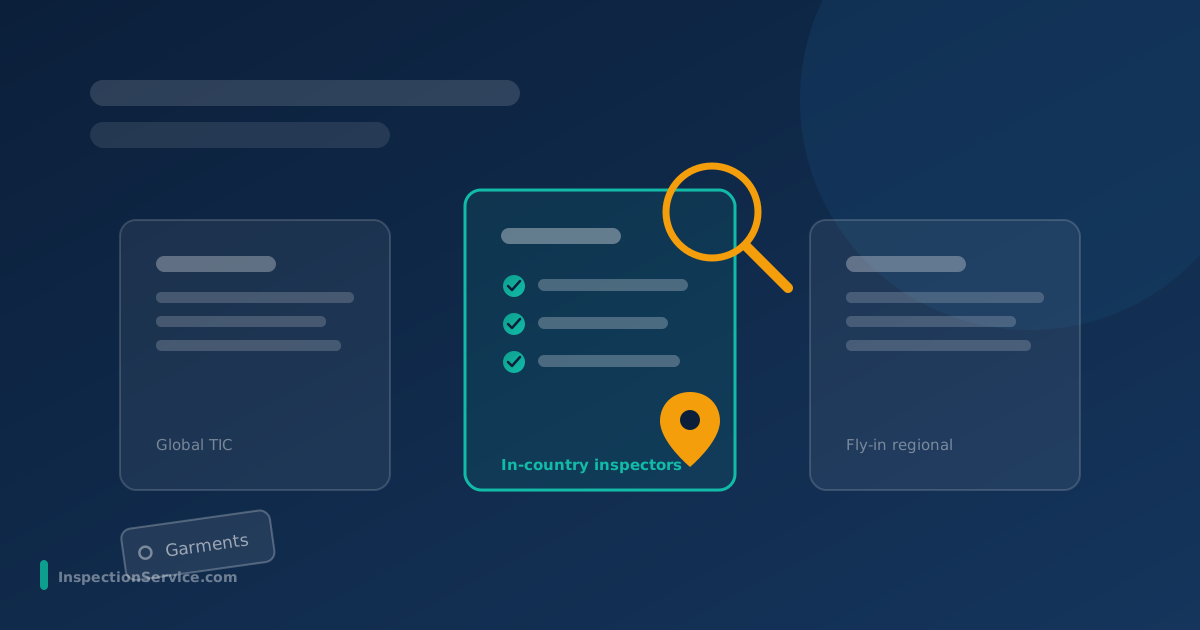
Three tiers serve the country, and the trade-offs are consistent:
| Tier | Strengths | Trade-offs |
|---|---|---|
| Global TIC firms | Brand recognition your customers may require, deep protocol libraries, accredited social-compliance capability | Higher pricing, less flexibility, often managed from regional hubs |
| Regional Asian firms | Often the sweet spot on price and responsiveness; cover Cambodia from China, Vietnam or Thailand | May fly inspectors in — travel fees and lead time — unless they keep in-country staff |
| Local independents | Best day rates, local language, strongest in garments and footwear | Smaller pool than China or Vietnam; verify reporting standards and independence with extra care |
The checklist: what to verify before booking
- Product-category track record. Cambodia means garments, footwear and travel goods for most buyers. Ask for a sample report in your category — for apparel that means GSM checks, needle detection, care labels and measurement specs, not a generic checklist with "fabric OK" boxes.
- Accreditation and process. ISO 17020 accreditation (inspection bodies) is the relevant flag; beyond paper, the sample report should show AQL sampling done properly — random draw from sealed cartons, defect log tallied against accept/reject numbers, real photos. How to pressure-test a report →
- In-country coverage. Confirmed inspector base in Phnom Penh (or near your factory's SEZ), quoted travel fees in writing if your factory sits outside it.
- Independence. Not recommended by your factory or agent, and no sourcing-side business with your supplier. The fox-and-henhouse rule has no exceptions.
- Booking-to-report speed. Cambodia's smaller market means thinner inspector coverage than China or Vietnam — 48–72h booking lead is normal; same-day reports should still be standard.
- Price transparency. All-in man-day pricing with travel spelled out. Cambodia rates run in the same regional band as Vietnam and Thailand — the cost logic explained here — but travel surcharges are where quotes diverge.
Cambodia-specific pitfalls
The subcontracting shuffle. Cambodia's garment sector has a long tail of small subcontractors around the registered exporters. Your PO may name a compliant flagship factory while cutting and sewing happen elsewhere. Brief your inspector to verify the production site matches the booking — and consider a DUPRO mid-production on first orders, not just a PSI.
Holiday compression. Khmer New Year (April) and Pchum Ben (September–October) shut factories for days and compress production on either side — exactly when defect rates spike and inspector calendars fill. Book earlier than you think you need to in March and September.
Language and management layers. Many export factories run with foreign management (Mandarin, Korean) above a Khmer-speaking floor. An inspector who can work in the factory's actual management language resolves findings on the spot instead of by email chain a week later.
EBA and origin paperwork. Cambodia's trade-preference status with the EU has been partially suspended since 2020, and documentation scrutiny is real. Inspection can't fix tariff issues, but a proper PSI verifies carton markings, labels and origin declarations match your paperwork — cheap insurance against customs friction.
So who is the "best"?
That's the whole formula — and which specific firm fits it depends on where your factory is and what you make. This is exactly the matching problem our marketplace exists to solve: tell us the product, the factory location and the date, and compare quotes from vetted providers with real Cambodia coverage instead of guessing from Google results.
Frequently asked questions
Per man-day, in the same regional band as Vietnam and Thailand. The variable that moves quotes most is travel: factories outside Phnom Penh's orbit often carry surcharges if the provider lacks in-country inspectors near your SEZ. Always ask for all-in pricing.
48–72 hours is typically enough in and around Phnom Penh, longer for remote SEZs. Around Khmer New Year (April) and Pchum Ben (September–October), book a week or more ahead — factories compress production around the holidays and inspector calendars fill.
Yes — all major TIC firms operate there, typically managed from regional hubs. The practical question is whether the inspector who shows up is based in Cambodia or flies in with travel charges attached. Ask directly.
Many regional firms cover Cambodia competently — some with in-country staff, some fly-in. The distinction matters for cost and speed, not capability. Confirm where the inspector is based before comparing quotes.
The same standard as anywhere: AQL sampling from sealed cartons, measurement specs against tolerance, fabric weight (GSM), care-label and market-compliance checks, needle detection for anything stitched, barcode scans, and a defect log tallied to accept/reject numbers.
On a first order from an unproven factory, a mid-production DUPRO plus the PSI is the safer setup — subcontracting is the classic Cambodia surprise, and a mid-run visit catches it while there's still time to react.